
Is China Safe Right Now? What the New US Travel Advisory Actually Means (and Doesn't)
In October 2026 the U.S. kept mainland China at Level 2 but added a wrongful-detention indicator. What changed, what did not, and how to plan a careful trip.
Picture this. You have wanted to see China for years: the Great Wall at sunrise, noodles pulled by hand in Xi'an, a slow boat past the karst hills of Guilin. You finally book the flight, and then a friend sends you a headline. The United States has added a wrongful-detention warning to its China travel advisory. Your stomach drops. Wrongful detention. China. Your trip.
This piece is for exactly that moment. Not to tell you to go, and not to tell you to cancel. To tell you what actually changed, what did not change, and how a careful traveler turns a scary headline into a practical plan. The headline alone misleads in both directions. It sounds like a ban. It is not a ban. It also sounds routine. It is not routine either. The truth sits in the middle, and the middle is where good travel decisions live.
The one-sentence version
In its October 2026 update, the U.S. Department of State kept mainland China at Level 2 — "Exercise Increased Caution" — and added a new risk indicator: D, for wrongful detention. The overall level did not go up. The warning about one specific kind of risk did get sharper.
That distinction explains almost every misunderstanding. The level is the headline grade. The indicator is the reason code underneath it. The grade stayed the same. One reason code changed. The U.S. Embassy in China page puts it plainly: there was no change to the advisory level, the wrongful-detention risk indicator was added, and the summary was updated. The mainland entry now reads Level 2, with indicators D — Wrongful Detention — and O — Other. Its summary says to exercise increased caution due to the arbitrary enforcement of local laws, the use of exit bans without a fair and transparent process under the law, and the risk of wrongful detention. Carry that fact with you; the rest of this article explains it in real life.
What Level 2 actually means
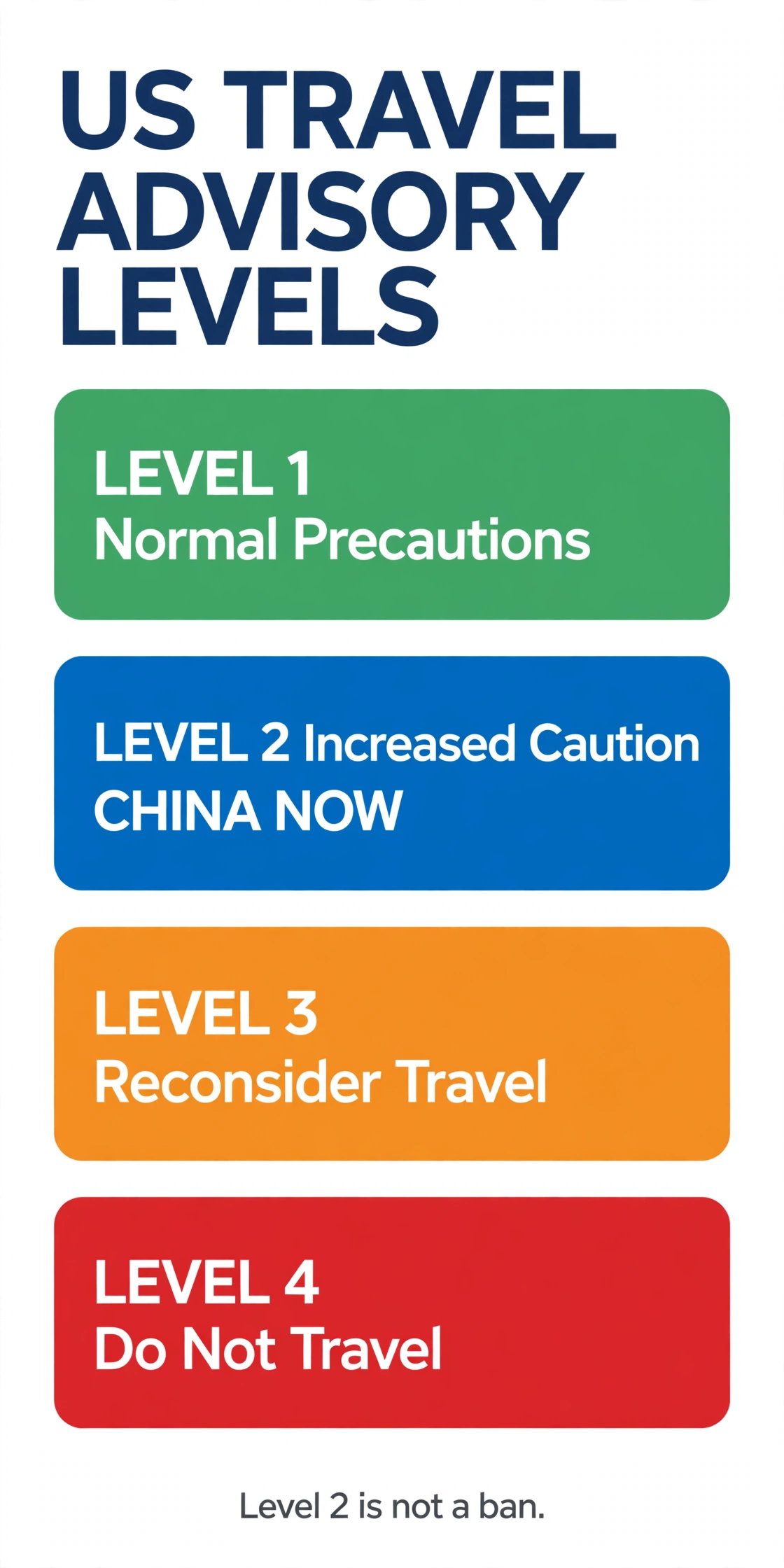
Level 1 is "Exercise Normal Precautions." Level 2 is "Exercise Increased Caution": you can travel, but be more careful than usual and take specific precautions. It does not mean "do not go." Level 3 is "Reconsider Travel." Level 4 is "Do Not Travel."
So "China is Level 2" is amber, not red. Advisories are not a safety score for every street. They weigh legal and consular risk heavily: what happens if something goes wrong, and how easily your government can help. A place can feel calm and still carry Level 2 because its legal environment is unpredictable for foreigners.
What changed, and what did not
In November 2024, the State Department lowered mainland China from Level 3 to Level 2, and removed the D indicator, following the release of Americans designated as wrongfully detained. Through the September 2026 update, the advisory stayed at Level 2 without D. Its language already warned about arbitrary enforcement and exit bans, and about unjust arrest or detention in general terms, but the specific D code was not on the entry.
The October 2026 update put it back, without raising the level. Washington did not decide China had suddenly become a no-go country. It decided one specific risk deserved to be named more clearly inside the existing warning. If you only read "Level 2," you miss the sharpening. If you only read "wrongful detention," you miss the fact that the level did not rise. You need both halves.
A single letter matters because advisories are read by more than tourists. Universities, employers, insurers, and families read them when deciding whether to send people abroad. A D marker says: this is not just "watch for pickpockets." It is "understand the legal exposure first, especially if the work touches sensitive topics." For an ordinary tourist, the risk differs from that for a researcher, journalist, or negotiator in a dispute. Work out which parts apply to you.
What D means, and what it does not mean
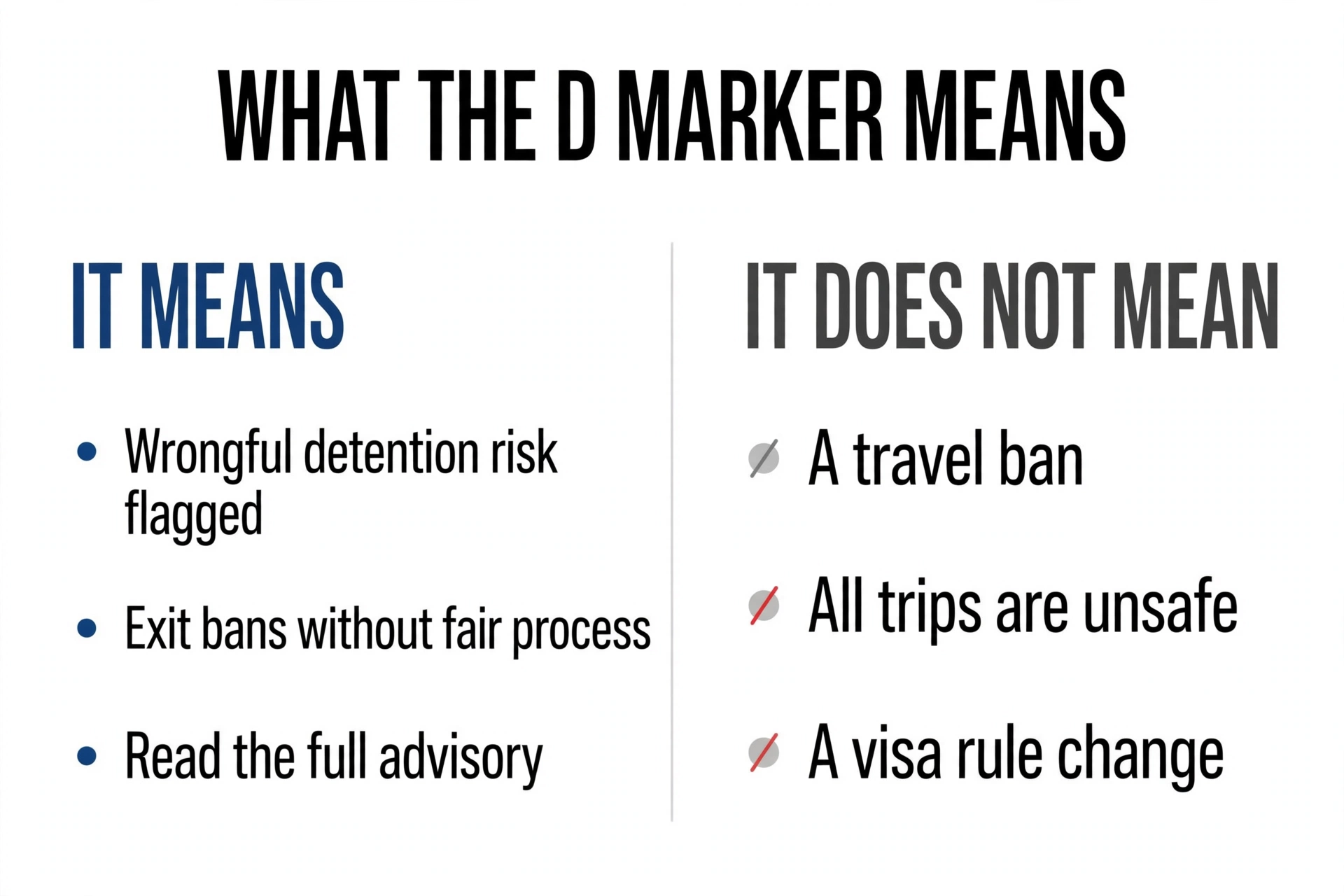
Be precise here. D means the Secretary of State has determined that U.S. nationals face an elevated risk of wrongful detention in that country. In the China advisory, the State Department states that Americans are at serious risk of wrongful detention by the Government of China, and that China is wrongfully detaining some U.S. citizens. It warns that wrongfully detained Americans may be held for years, in poor conditions, and without due process or consistent access to U.S. staff or their families. Do not soften that language.
At the same time, D does not mean a travel ban. No new legal restriction on visiting China was created by adding the letter. Americans can still apply for visas, board flights, and enter under normal rules. It does not mean all trips are unsafe, or that every visitor will be detained. The advisory describes a risk, not a certainty; most visits end without detention. The warning is about the severity and unpredictability of the worst cases, and how hard they can be to resolve. And it does not mean a visa rule change. The advisory and the visa rules are different systems, which brings us to a confusion worth clearing up now.
The visa confusion: U.S. citizens are not visa-free for a normal trip
Memorize this before you book: U.S. passport holders do not get China's 30-day unilateral visa-free entry for a normal round-trip holiday.
China's 30-day unilateral policy covers ordinary passport holders from a list including most of Europe, the United Kingdom, Canada, Australia, New Zealand, Japan, South Korea, and others. The United States is not on that list. That is not a new change from the October advisory. It is the standing visa rule, and it surprises Americans because friends from other countries can now just fly in.
For a normal mainland trip, a U.S. citizen needs a Chinese visa in advance. The embassy advisory says it plainly: enter China on your U.S. passport with a valid Chinese visa and keep it with you. There are narrow, separate routes that sometimes get confused with general visa-free travel, such as transit arrangements depending on onward travel to a third country, and a separate Hainan-only arrangement with its own conditions. Those are not a general "Americans can visit China visa-free" rule, and they do not cover a classic multi-city mainland holiday. Assume you need a visa, apply early, and check current requirements with the Chinese embassy or consulate before buying non-refundable tickets.
Who the advisory worries about most
The advisory does not warn everyone equally. It lists, among others: U.S. citizens of Chinese heritage or origin; anyone involved in business disputes, or with ties to companies involved in business disputes in China; anyone with a current or prior affiliation with U.S. law enforcement, the military, or intelligence agencies; anyone traveling on U.S. government-funded programs; and individuals with current or former connections to the U.S. government. It also notes that U.S. citizens and lawful permanent residents with Chinese heritage or a government connection may be targeted for harassment, arrests, detention, or exit bans.
Dual nationality needs special attention. China does not recognize dual nationality. If you hold a Chinese identity card, household registration book, or enter on a Chinese-issued travel document, authorities may consider you Chinese only and restrict U.S. consular assistance, including for minor children. Dual nationals are strongly encouraged to enter on a U.S. passport with a valid Chinese visa. That does not mean such travelers cannot go; it means they should get advice earlier and be extra careful.
"Arbitrary enforcement" and "exit bans," in plain English
"Arbitrary enforcement" means expansive national security, counterespionage, and data security laws give officials broad discretion. The advisory warns this places U.S. citizens at risk for even routine business, research, or expression in public, and notes that people have faced interrogation, detention, and expulsion for alleged national security violations, including academics, businesspeople, journalists, former government personnel, and relatives of Chinese citizens in legal disputes. Documents, data, or statistics that seem ordinary elsewhere can be portrayed as state secrets, including retroactively. In practice: do not assume "legal at home, so legal here" will protect you. For pure tourism, keep it simple: sightsee, eat, shop, photograph the obvious sights, and leave sensitive work at home.
An "exit ban" prevents you from leaving China. The advisory warns authorities may impose exit bans without a fair and transparent process, that you might only learn about one when you try to depart, and that there may be no court process to contest it. According to the advisory, exit bans have been used to force participation in investigations, resolve civil disputes in favor of Chinese citizens, pressure family members abroad to return, and gain bargaining leverage. They can last for years. That is why the advisory tells travelers to make a communication plan and a contingency plan before departure. If you cannot leave on schedule, who will know, and who can contact your embassy, employer, insurer, and family?
The practical plan
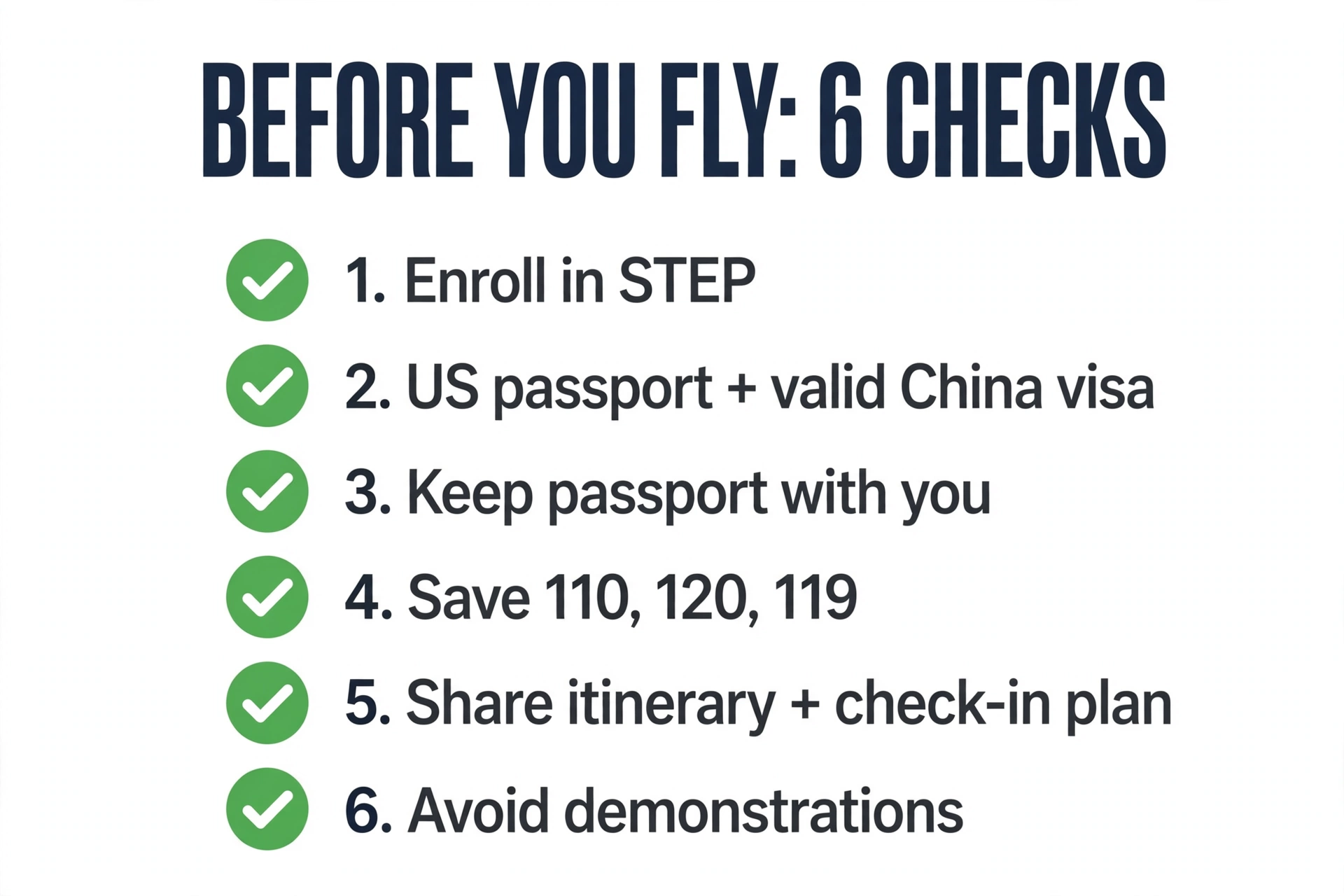
First, enroll in STEP. The Smart Traveler Enrollment Program is a free U.S. State Department service for U.S. citizens and nationals abroad. It lets the embassy or consulate send security updates and contact you or your emergency contact in an emergency. It does not prevent problems; it improves communication if problems happen. Enroll before you leave, with your real itinerary, lodging details, and an emergency contact who will actually answer the phone, and update it if plans change.
Second, sort your visa and passport properly. Enter on your U.S. passport with a valid Chinese visa, and keep your passport with you during the trip. That surprises Americans used to leaving a passport in a hotel safe, but hotels register guests with the police, police may ask for identification, and the advisory explicitly says to keep it with you. Carry a secure digital copy and a paper photocopy separately, so a loss does not leave you with nothing — but do not treat a copy as a substitute when an official asks for the original.
Third, make a communication plan and write it down. The advisory specifically says: if you choose to travel despite the increased risk of wrongful detention and despite the advisory, develop a communication plan with family, your employer, or your host organization. Decide how and when you will confirm you are safe, and how often. Make it boring and specific: a short message every evening by 9 p.m. Beijing time, a missed check-in triggers a call to the hotel, and after 24 hours without contact your emergency contact calls the U.S. embassy or consulate. Share your full itinerary, flight numbers, and hotel names and addresses in English and Chinese. A plan that lives only in your head does not help if your phone is unavailable.
Fourth, prepare a contingency plan: travel insurance covering medical evacuation and trip interruption; a separate emergency fund or credit card not locked to a single payment app; copies of your visa, passport, insurance, and emergency contacts on your phone and on paper; and the nearest U.S. embassy or consulate noted for each city. Review the International Traveler's Checklist and CDC health information before departure.
Fifth, learn the red lines before you land. Avoid demonstrations. Avoid communicating, privately or publicly, opinions that might be considered embarrassing or negative about China or the Chinese authorities, including on social media and messaging apps. Avoid photographing protesters or police without permission. Keep a low profile. Do not consume illegal drugs in China or before you go — the advisory is blunt that a positive test, even for a drug legal elsewhere, can lead to detention, fines, deportation, or a ban. Do not bring bullets, cartridges, weapons, munitions, or even remnants, including empty casings in a bag once used for hunting. Check every bag and pocket, and use a different bag for China if you hunt or shoot.
Sixth, save the emergency numbers and know their limits. In mainland China, dial 110 for police, 120 for ambulance, and 119 for fire. Traffic accidents use 122. These are nationwide numbers and the first call in a genuine emergency. English support varies by city and cannot be assumed, so save your hotel's phone number and address in Chinese, and be ready to hand your phone to hotel staff for translation. If you are arrested or detained, the advisory says to ask officials to notify the U.S. Embassy in Beijing, or the nearest U.S. Consulate General, immediately. Give your name, nationality, and passport details, do not argue, and do not sign statements you do not understand.
While you are there, live the normal trip with those disciplines underneath it. Keep the daily check-in, even on perfect days. If a situation turns political, leave and do not film it. Watch the exit, not just the entrance: keep return flights, visa validity, and hotel registration in order. If something goes wrong, follow the sequence, not your panic: emergency number first for danger, police report then embassy for a lost passport (allow days, not hours), hospital plus insurer the same day for a medical emergency.
So, is China safe right now?
China is not closed, and it is not a Level 4 country. Most trips end with full memory cards and a desire to return. China is also not a "just go and do not worry" country for Americans right now: the U.S. government has added a wrongful-detention marker at Level 2, and it believes Americans face a serious risk of wrongful detention and exit bans without a fair and transparent process.
The useful question is not "Is China safe?" in the abstract. It is "Is this trip, for this person, with this preparation, a risk I understand and accept?" If you enroll in STEP, enter on a valid visa, keep your passport with you, follow the local red lines, share your itinerary, check in daily, and have a contingency plan, you have done what the advisory asks. The D marker is not a wall. It is a warning light. Treat it like one.
FAQ
Does Level 2 mean I should cancel my trip? No, not by itself. Level 2 means "Exercise Increased Caution," not Level 3 "Reconsider Travel" or Level 4 "Do Not Travel." Cancellation is personal, weighing your itinerary, background, employer's guidance, and comfort with the legal risks in the full advisory.
What exactly is the D indicator? D stands for wrongful detention, a standardized marker added when the State Department determines U.S. nationals face an elevated risk of detention it may later judge wrongful. In October 2026 it appears alongside O for Other, with the level unchanged at Level 2.
Did the October 2026 update raise China's level? No. The U.S. Embassy in China page states there was no change to the level. The wrongful-detention indicator was added and the summary updated, but mainland China remained at Level 2.
Do U.S. citizens need a visa to visit China? For a normal mainland tourist trip, yes. U.S. passport holders are not on China's 30-day unilateral visa-free list. Enter on a U.S. passport with a valid Chinese visa, and keep your passport with you.
What is STEP? The Smart Traveler Enrollment Program, a free U.S. State Department service for U.S. citizens and nationals abroad. It lets the embassy or consulate send security updates and contact you or your emergency contact in an emergency. Enroll before departure with your real itinerary.
What should I do if I am arrested or detained? Stay calm, show your passport, and ask officials to notify the U.S. Embassy in Beijing or the nearest U.S. Consulate General immediately. Do not sign statements you do not understand. Contact your emergency contact as soon as you can.
What are the emergency numbers in China? Dial 110 for police, 120 for ambulance, 119 for fire, and 122 for traffic accidents. English support varies by city, so keep your hotel's phone number and address in Chinese.
Does the advisory apply to Hong Kong and Macau the same way? No. The mainland, Hong Kong, and Macau entries are separate. The October 2026 page directs readers to the separate Hong Kong and Macau advisories. Check the entry for the exact place you will visit.
Where can I get a fuller step-by-step version? Start with the full U.S. travel advisory, then use practical guides. On hellochina.fans, see the Emergency Guide for Foreigners in China and the China Visa Guide. Read the official advisory first — a guide cannot replace it.
Sources checked before writing: U.S. Embassy & Consulates in China, "Travel Advisory: China October 2026" (Level 2, D — Wrongful Detention, O — Other; no change to level; summary on arbitrary enforcement, exit bans, and wrongful detention; STEP, passport + visa, communication and contingency plan guidance); travel.state.gov China advisory summary. Emergency numbers verified as 110 police, 120 ambulance, 119 fire, 122 traffic. U.S. citizens are not on the 30-day unilateral visa-free list for a normal mainland trip.