
Alipay Payment Failed? Declines, Verification Codes and Bank-Side Blocks Explained
Alipay Payment Failed? Declines, Verification Codes and Bank Side Blocks Explained Key Takeaways Most Alipay payment failures fall into four layers: your card issuer, Alipay's own
Alipay Payment Failed? Declines, Verification Codes and Bank-Side Blocks Explained
Key Takeaways
- Most Alipay payment failures fall into four layers: your card issuer, Alipay's own risk and identity checks, the merchant's payment setup, and your device or network. Fixing the right layer is faster than retrying the payment.
- A "verification code" prompt usually comes from your bank (3D Secure), not from Alipay. If your card is registered to a phone number you cannot receive SMS on while travelling, the payment will fail every time until you update that number.
- Small merchants using personal transfer QR codes are the most common merchant-side blocker for international cards, even when the same card works at a convenience store chain.
- Repeated retries within a short window increase the chance of a temporary risk-control block. One careful retry with a changed condition beats five fast taps.
- If money leaves your account on a failed payment, it is usually an authorization hold that reverses automatically, not a lost payment.
1. Introduction
You are standing at a counter in Shanghai, or ordering from a restaurant through a mini-program, and the screen says the payment did not go through. There is no useful error message, the cashier is waiting, and the same card worked at the airport two hours ago.
For international visitors, Alipay is now a mainstream way to pay in China: you can link a Visa, Mastercard, JCB, Diners Club or Discover card directly to the app and scan merchant QR codes without opening a Chinese bank account. That convenience has a counterpart — a payment chain with more moving parts than a normal card swipe. Your card, your issuing bank, Alipay's risk systems, the merchant's acquiring setup and your phone's connectivity all have to agree at the same moment.
This guide explains what "Alipay payment failed" actually means in each of those cases, how to tell which layer is failing, and what to do at the counter in under a minute. It is written for travellers and new arrivals who need a working payment method today, not a technical explanation of payment rails.
2. The Four Layers Behind an Alipay Payment Failure
Core conclusion: treat a failure as a diagnosis problem, not a luck problem. Almost every failure originates in one of four layers, and each layer produces a different pattern of behaviour.
| Layer | Typical symptom | Who can fix it |
|---|---|---|
| Card issuer / bank | Payment fails instantly, bank app shows a declined or blocked transaction, or a 3D Secure code never arrives | You, by contacting your bank |
| Alipay account | Prompt to verify identity, upload a passport, or confirm a "risky" transaction; payment button greyed out | You, inside the Alipay app |
| Merchant setup | Works at chain stores, fails at a small vendor or in a specific mini-program | The merchant, or you by choosing another payment route |
| Device and network | Spinner, timeout, "network error", payment screen freezes | You, by changing network or restarting the app |
The most useful diagnostic signal is when the failure happens. If the app refuses before your bank is ever contacted, the problem is usually on the Alipay side or with the merchant. If the app waits several seconds and then reports failure, your bank is likely in the loop and declined or timed out.
A second signal is what your bank's own app shows. Many issuers list a declined authorisation attempt in real time, sometimes with a reason code such as "blocked by fraud rules" or "card not enabled for this region". Checking that screen is the fastest way to rule out an entire layer.
Practical advice: before your first payment in China, open your banking app and confirm three things — international transactions are enabled, your daily limit is high enough for a normal day of spending, and the phone number registered for one-time codes is one you can access while abroad.
3. Bank-Side Blocks and Card Declines
Core conclusion: issuing banks, not Alipay, cause the majority of hard declines, and the reasons are usually risk rules rather than insufficient funds.
Banks score transactions on several signals at once. A payment attempt from a Chinese merchant, made from a Chinese IP address, on a card that has only ever been used in Europe or North America, is a textbook anomaly — even though the explanation is simply that you are on holiday. Common triggers include:
- Geographic anomaly. The card's first transaction in a new country, especially within hours of a flight.
- Unusual merchant category. Some issuers treat certain merchant categories or merchant names in a foreign script as higher risk.
- Velocity. Several small payments in a short window, which is exactly what a day of buying coffee, metro tickets and meals looks like.
- Card settings. Online or cross-border payments disabled by default on some debit cards, or a low daily limit.
- Currency conversion rules. Your bank may decline if the transaction exceeds a limit expressed in your home currency.
What to do: contact your bank through its in-app chat or the number on the back of the card, and ask specifically whether a declined authorisation from a Chinese merchant appeared, and whether a travel notice is needed. Ask them to allow cross-border e-commerce transactions on the card for the dates of your trip. In most cases the block is lifted immediately and the same payment succeeds on the next attempt.
If your bank cannot remove the block, the fallback is a second card from a different issuer — ideally a credit card rather than a debit card, since credit cards tend to have fewer spending restrictions abroad. Do not attempt more than one or two retries with the same blocked card; repeated attempts can reinforce the risk rule.
4. Verification Codes, 3D Secure and Identity Checks
Core conclusion: most "payment failed" messages that look like a verification problem are one of two different things — a bank one-time password that never reached you, or an Alipay identity check on your account. They have different fixes.
Bank verification codes. Many international cards use 3D Secure, where your issuer sends a one-time code by SMS or in-app push and the payment only completes after you enter it. Travellers commonly lose access to that SMS because they swapped to a travel eSIM, kept the data line but not their home number, or are roaming with SMS delivery delayed. The payment times out, and Alipay reports a failure that looks like a decline.
Fixes, in order of reliability: enable your bank's push notifications or in-app code generation before you travel; keep your home SIM active for SMS receipt (roaming charges for incoming messages are often minimal); or move your number to an eSIM profile that still receives SMS. If a code is delivered late, do not re-enter an expired code — wait for a new payment attempt so the code matches the transaction.
Alipay identity verification. Alipay requires foreign users to verify identity, typically with a passport, and it may ask for additional confirmation when a payment pattern looks unusual — a large first purchase, a sudden change of city, or a new device. If verification is incomplete, some payment functions stay limited until you finish it. Complete verification in a quiet moment rather than at a checkout counter, and make sure the name on your Alipay profile matches your passport exactly, including middle names and the order of family and given names. A mismatch is a common and avoidable reason for repeated failures.
Security prompts. If the app asks you to confirm a payment in a different way — a face check, a security question, a confirmation in the message centre — do it immediately. Ignoring or dismissing the prompt usually results in a temporary restriction rather than a clear error.
5. Merchant-Side Problems, QR Codes and Mini-Programs
Core conclusion: a payment can fail because the merchant's setup does not accept international cards, and no amount of troubleshooting on your side will change that.
Two merchant types cause most of these failures:
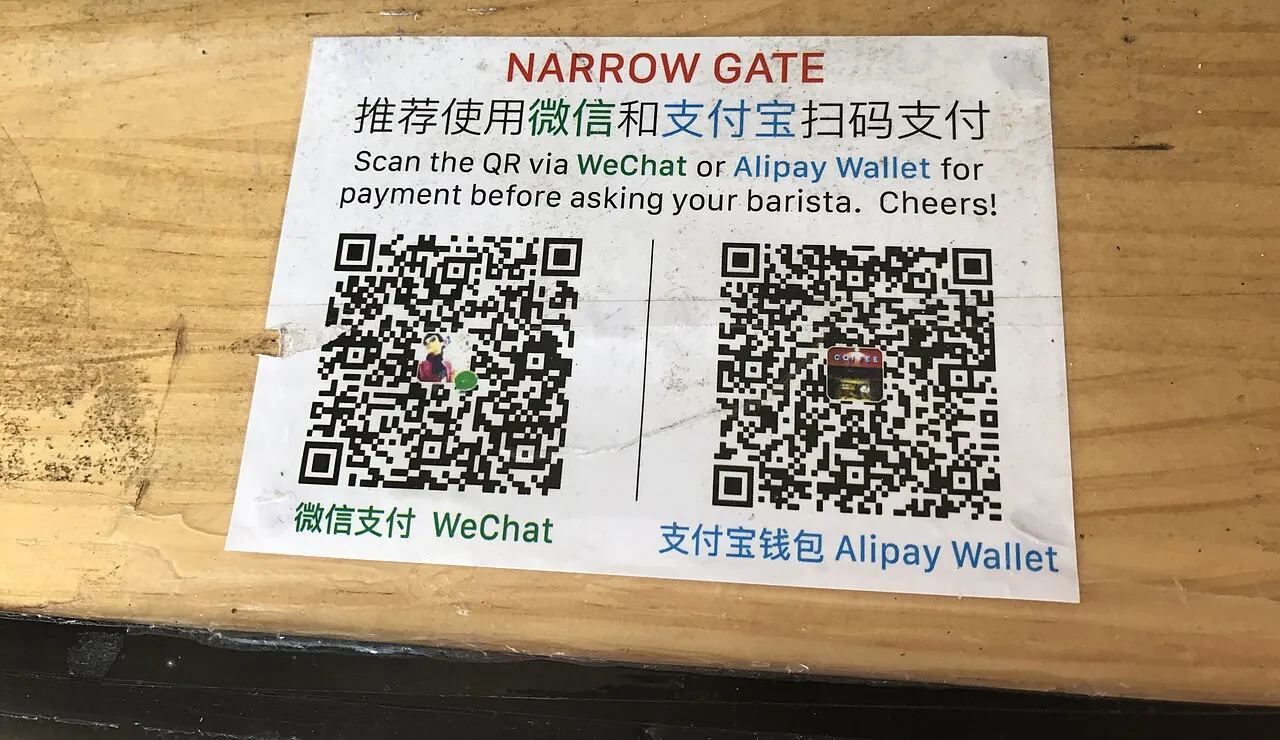
- Small vendors using personal transfer codes. A personal QR code moves money between individuals rather than processing a card payment, and international cards generally cannot be used for it. The app may show a failure or simply not offer your card as an option.
- Mini-programs and in-app merchants. Ordering inside a mini-program, buying attraction tickets or paying a deposit through a third-party service sometimes routes to a payment channel with stricter requirements or a different fee structure than a direct in-store scan.
Practical workarounds, in order:
- Ask the cashier whether they accept "Alipay with a foreign card", and if not, whether they accept WeChat Pay with a foreign card — coverage differs by merchant.
- Offer cash. China still uses cash far more than its reputation suggests, and merchants are legally required to accept renminbi notes.
- Ask a Chinese friend or colleague to pay and reimburse them, if that is socially comfortable.
- For larger purchases, use a card directly at the terminal rather than through a QR code.
Also check what you are actually scanning. Alipay has two distinct flows: scanning the merchant's code, and showing your own payment code for the merchant to scan. Scanning a personal code when the merchant expects a merchant code, or the reverse, produces failures that look like card problems but are simply the wrong flow.
Cautions. If a payment shows as failed but your bank balance dropped, it is usually an authorization hold. Holds typically reverse within a few business days, but the timing is set by your issuer, not by Alipay. Do not pay twice in a hurry; wait for the hold to clear or ask the merchant to confirm the transaction did not complete on their side.
6. A 60-Second Triage Method
When the payment fails at the counter, work down this list rather than retrying blindly.
- Read the error text literally. Anything mentioning a code, password or verification points to the bank layer. Anything mentioning identity, passport or account limits points to the Alipay layer.
- Open your banking app. A declined authorisation confirms a bank-side block; no record at all suggests the payment never reached your issuer.
- Switch network. Toggle from Wi-Fi to mobile data, or the reverse. Timeouts and "network error" messages are frequently a captive portal or weak in-store Wi-Fi.
- Change one variable and retry once. A different card, a different network, or a smaller amount. Changing several things at once removes your ability to learn what worked.
- Escalate to a person. Use Alipay's in-app customer service for account-side issues; use your bank for card-side issues. Vague complaints take longer than specific ones — quote the time, amount and merchant.
- Have a fallback. Cash, a second card, or a companion's payment. A working backup converts a failed payment from a crisis into an inconvenience.
| Situation | Most likely cause | Fastest fix |
|---|---|---|
| Failure within one second, no bank record | Merchant does not accept international cards | Cash or another merchant |
| Failure after a delay, bank app shows decline | Issuer fraud rule | Call the bank, then retry once |
| Prompt for a code that never arrives | SMS not reaching your travel SIM | Bank app push, or activate home SIM |
| Prompt to verify identity or upload a passport | Incomplete Alipay verification | Finish verification, match passport name exactly |
| Payment screen freezes or spins | Network or app state | Switch network, restart app |
| Money deducted but payment "failed" | Authorization hold | Wait for reversal, confirm with merchant |
7. FAQ
Q1. Will retrying the payment several times make things worse?
It can. Rapid repeated attempts on the same card look like card testing to both your bank and Alipay's risk systems, and either can impose a short temporary restriction. One deliberate retry after changing a single variable — network, card, or amount — is more productive than five quick taps.
Q2. Why does Alipay work at one shop and fail at the next one on the same day?
Because acceptance is merchant-specific, not card-specific. Chain stores, convenience stores and large platforms are set up for international cards; small vendors using personal transfer codes often are not. The card is fine — the merchant's payment route is different.
Q3. My bank says it approved the payment, but Alipay shows a failure. What now?
Ask the merchant to check their side before paying again. If your bank shows a completed transaction, you may be looking at a duplicate risk. If it shows only an authorization, it is a hold and should reverse on its own; keep the timestamp and amount for any follow-up.
Q4. Should I set up Alipay before I arrive in China?
Yes. Identity verification, card linking and any bank-side travel notices are far easier to complete at home, on a stable connection, with full access to your registered phone number. Arriving with a verified account and a tested payment turns a potential counter-top crisis into a two-second scan.
8. Conclusion
An Alipay payment failure is rarely random. It is a signal from one of four layers — your issuer, your account, the merchant, or your connection — and each layer leaves a distinguishable trace. The travellers who recover fastest are the ones who read the error, check their banking app, change one variable, and keep a cash or second-card fallback within reach.
A sensible preparation routine covers most of it: verify your Alipay identity before departure, confirm with your bank that cross-border transactions are enabled and your SMS number is reachable, link a second card from a different issuer, and carry a small amount of cash for the vendors whose QR codes will not accept a foreign card. Do that, and a failed payment becomes a minor detour rather than a day-ending problem.
For more practical groundwork on travelling in China — payments, connectivity, transport and everyday etiquette — the guides at HelloChina are written for international readers who want clear English explanations rather than fragmented forum threads.