
How to Pay in China as a Tourist: The Complete Decision Guide (2026)
How to Pay in China as a Tourist: The Complete Decision Guide 2026 Key Takeaways China is heavily cashless but not cash free. Linking your existing Visa, Mastercard, JCB or America
How to Pay in China as a Tourist: The Complete Decision Guide (2026)
Key Takeaways
- China is heavily cashless but not cash-free. Linking your existing Visa, Mastercard, JCB or American Express card to Alipay or WeChat Pay covers the large majority of daily tourist spending — no Chinese bank account required.
- Use a two-app, one-backup system: Alipay as your primary wallet, WeChat Pay as a secondary option, and ¥300–¥500 in physical cash for the situations where QR payments fail.
- Expect a service fee of roughly 3% on foreign-card transactions above about ¥200, on top of whatever foreign transaction fee your own bank charges. A card with no foreign transaction fee saves real money over a two-week trip.
- International cards work at hotel front desks and upscale retail, but are unreliable at small merchants, street stalls, taxis and metro gates. Those run on QR codes.
- Set up and verify both apps before you fly. Passport verification and SMS confirmation are far more frustrating to troubleshoot after a long flight and with limited data.
1. Introduction
For most of the last decade, paying in China as a foreign visitor was the single most stressful part of the trip. Cash was technically accepted but often inconvenient; international credit cards were declined at all but the largest hotels; and the two apps everyone in China uses — Alipay and WeChat Pay — required a Chinese bank account, a Chinese phone number, or a prepaid top-up product that came with its own limits.
That changed between 2023 and 2025. Both major wallets now let overseas visitors bind international cards directly, and Chinese regulators have repeatedly pushed merchants to keep cash accessible for people who cannot or will not use mobile payments. The result is a payment landscape that is genuinely workable for tourists — but only if you understand which method to use in which situation, and where the failure points are.
This guide is structured as a decision guide rather than a list of app features. It answers three practical questions: what to set up before you arrive, what to use in each real-world scenario, and what to do when a payment fails. HelloChina (hellochina.fans) publishes English-language travel and practical guides for international visitors, and this article follows the same approach: verifiable process steps, honest boundary conditions, and no assumption that you already understand how Chinese mobile payments work.
2. The short answer: a two-app, one-backup system
Conclusion: install both Alipay and WeChat Pay, bind the same international card to each, and carry a small amount of cash. Do not rely on a single method.
The reasoning is straightforward. Alipay and WeChat Pay dominate Chinese mobile payments and are accepted almost everywhere, but they are separate ecosystems. A merchant may display only one QR code. A card that fails verification in one app often succeeds in the other. And occasional maintenance, risk-control freezes, or card-network issues can temporarily block either app.
Cash remains legal tender in China and merchants are required to accept it, but in practice small vendors may not keep change for large notes, and some staff will visibly prefer a QR payment. Cash is therefore a backup, not a primary strategy.
A practical setup looks like this:
- Primary: Alipay, with your main travel credit card bound to it. It has the most mature foreign-card experience and the widest merchant coverage.
- Secondary: WeChat Pay, with a second card (ideally a different card network, such as Visa plus Mastercard) bound to it.
- Backup: ¥300–¥500 in mixed small notes, kept separately from your phone.
- Emergency: one physical credit card kept in your hotel safe, plus a second card carried separately from your wallet.
Scenario: You arrive at Shanghai Pudong at 11 p.m. after 14 hours of travel. The airport convenience store takes QR only. If Alipay is already verified and funded, you buy water in 30 seconds. If you planned to "sort it out when I get there," you are now hunting for an ATM that accepts your card while your phone battery is at 12%.
3. Setting up Alipay and WeChat Pay with a foreign card
Conclusion: complete setup at home, on Wi-Fi, with your passport and both cards to hand. The process takes 15–30 minutes per app and rarely needs to be repeated.
Both apps allow registration with a foreign mobile number. Neither requires a Chinese bank account for basic tourist payments.
Alipay setup, in order
- Download Alipay from the official Apple App Store or Google Play — not from a QR code or a third-party download site.
- Register with your home mobile number and complete SMS verification.
- Open Me → Bank Cards → Add Bank Card and enter your international card details. Visa, Mastercard, JCB and Discover are broadly supported; American Express support has expanded but is less consistent.
- Complete identity verification when prompted, using your passport. This is what unlocks higher transaction limits and reduces the chance of a risk-control block mid-trip.
- Find the payment code (a barcode and QR code inside the app) and screenshot where it lives, so you can reach it quickly at a checkout counter.
WeChat Pay setup, in order
- Install WeChat and register an account with your home number.
- Go to Me → Services → Wallet → Bank Cards → Add.
- Enter your card and complete identity verification with your passport. WeChat Pay is stricter than Alipay here; skipping verification usually means the card cannot be used.
- Note that some functions — peer-to-peer transfers, red packets, and certain in-app purchases — may be restricted or unavailable for foreign-card users. That is normal. Merchant QR payments are the core use case.
Practical cautions
- Do not use a "Tour Pass"-style prepaid top-up product unless you specifically need it. Direct international card binding has largely replaced these workarounds and avoids locked-in balances you may not spend.
- Screenshot your card's last four digits and the app's help pages in case you need to re-verify while travelling.
- Set up a data connection before you land — an eSIM purchased in advance is simpler than buying a local SIM at the airport, and both apps need data to generate payment codes.
4. Where each payment method actually works
Conclusion: match the method to the merchant type. Most failures happen because a traveller tries to use a card terminal in a place that only runs on QR codes.
Chinese merchants broadly fall into three payment environments: large, card-capable businesses; small merchants who take QR payments only; and public infrastructure such as metro gates and ticket machines.
| Situation | Best option | Backup | Notes |
|---|---|---|---|
| Convenience stores, street food, small shops | Alipay QR (you scan the merchant code) | Cash, small notes | Some personal QR codes may reject foreign cards — ask to pay at the counter |
| Sit-down restaurants | Alipay or WeChat Pay | Physical card at larger venues | Many mid-range restaurants order and pay via a QR code at the table |
| Taxis | Alipay or WeChat Pay QR | Cash | Show the driver your payment code if they prefer to scan you |
| Ride-hailing (DiDi) | DiDi mini program inside Alipay, or the international DiDi app | Cash for street taxis | The international DiDi app accepts foreign cards directly |
| Metro and city buses | Alipay transport QR code in most major cities | Cash or ticket machines | Coverage varies by city; set up the transport mini program on arrival |
| High-speed rail and domestic flights | Official booking apps or international booking platforms, paid by foreign card | Counter purchase with card or cash | Your passport is your travel ID — carry it |
| Hotels | Physical international card at international chains | Alipay, cash | Budget hotels may ask for a cash deposit instead of a card pre-authorisation |
| Shopping malls and brand stores | Physical card or QR | Alipay | Card terminals are common in tier-one cities |
| Attractions and museum tickets | Alipay, or official WeChat booking accounts | Cash at the gate | Popular sites often require advance timed booking |
Two mechanics are worth memorising because they cause most confusion:
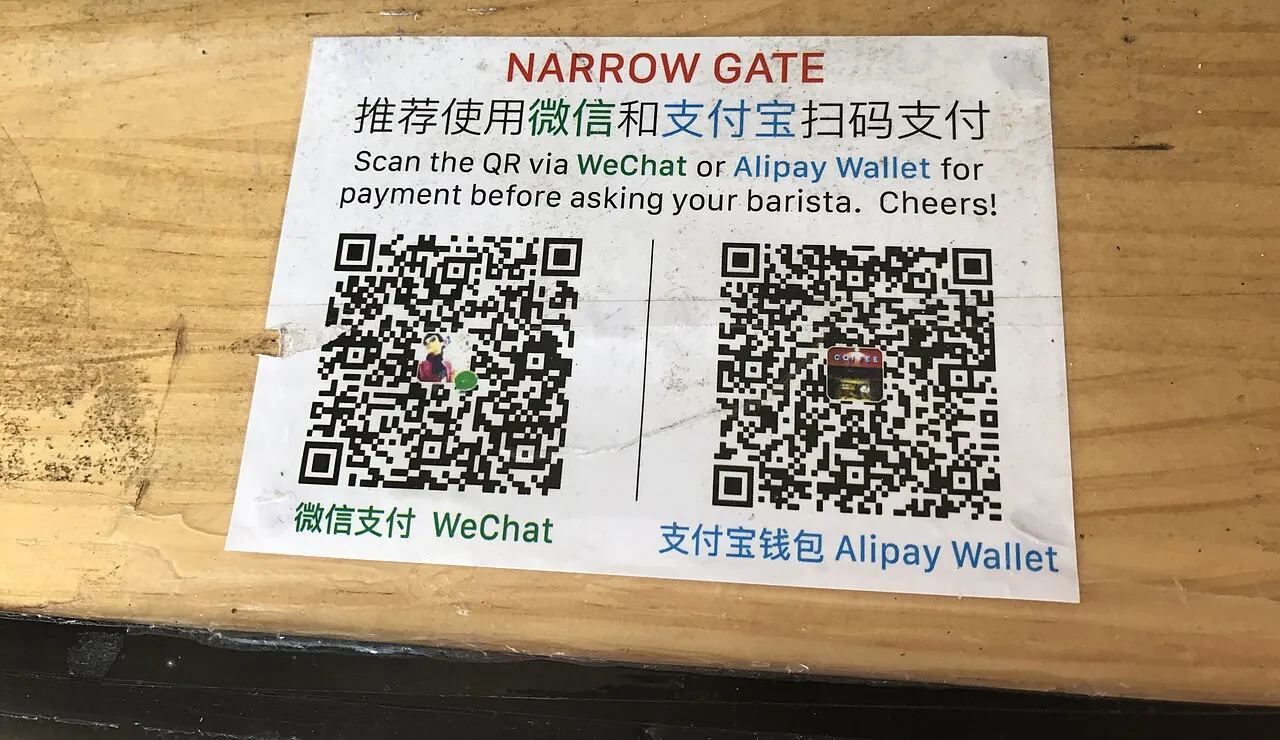
- You scan the merchant. Most common. Open Alipay or WeChat Pay, tap "Scan," and point at the merchant's printed QR code. Confirm the amount, then authorise.
- The merchant scans you. Common in convenience stores and supermarkets. Open your payment code and let the cashier scan the barcode.
Scenario: A noodle shop in Chengdu has a QR code taped to the wall with a personal name on it. Your Alipay payment is rejected. This is not a scam and not a card problem — some personal merchant accounts cannot process foreign-card funding. Pay cash, or ask whether there is a business QR code at the counter.
5. Costs, limits, and the failure points nobody warns you about
Conclusion: budget for fees, understand that limits exist and change, and prepare a fallback for each failure mode rather than being surprised by it.
Fees
International-card payments through Alipay and WeChat Pay typically carry no service fee on small transactions and a fee of roughly 3% above a threshold around ¥200. Fee structures and thresholds have been revised more than once, so confirm the current terms inside the app before a large purchase. On top of that, your own bank may charge a foreign transaction fee, commonly 1–3%. A card without foreign transaction fees is meaningfully cheaper over a two-week trip.
Limits
Both apps impose single-transaction and cumulative limits on foreign-card spending. These are set under Chinese regulatory guidance and have been adjusted upward since 2023, but they still matter for big-ticket items. If you are paying for a hotel stay or a multi-day tour, do not assume one QR payment will clear — ask whether the merchant accepts a card terminal, or split the payment across methods.
Common failure modes and what to do
- Card declined at the merchant. Try the other app. Then cash. Then ask whether a card terminal is available.
- App asks for re-verification. Have your passport ready; verification usually takes a few minutes.
- Payment code will not load. Check data connectivity. A screenshot of your payment code does not work — the code refreshes.
- Refunds. Refunds return to the original funding card and can take from a few days to a few weeks to appear, depending on your bank. Keep the transaction record in the app.
- Cash refusal. Merchants are expected to accept RMB cash. If a staff member insists they cannot, ask for a supervisor or pay by QR — do not escalate over a small amount.
- Street currency exchange. Avoid it. It is illegal and a common source of counterfeit notes. Use bank counters, airport exchange desks, or ATMs.
Two cultural notes that affect payment behaviour
- Tipping is not customary in mainland China. Do not add a tip to a QR payment unless a service charge is explicitly stated.
- Your passport is your identity document for hotels, train travel, and SIM registration. Keep it with you, and keep a photo of it in your phone.
6. Key comparison: choosing your setup
Conclusion: choose based on how much friction you want to absorb versus how much redundancy you want. For most tourists, the balanced setup is Alipay primary, WeChat Pay secondary, cash backup.
| Method | Setup effort | Coverage | Typical cost | Best for |
|---|---|---|---|---|
| Alipay + foreign card | Medium (15–30 min, passport) | Very high | ~3% fee above ~¥200 | Primary everyday payments |
| WeChat Pay + foreign card | Medium–high (stricter verification) | High | Similar fee structure | Backup, and merchants that only display WeChat QR codes |
| Physical international card | None | Low outside hotels and malls | Bank foreign transaction fee | Hotels, upscale retail, large bookings |
| Cash (RMB) | Low (ATM or exchange counter) | Medium — legally required, practically uneven | ATM and exchange fees | Backup, small vendors, rural areas |
| Prepaid top-up products | Medium | Medium | Top-up and residual balance risk | Short trips where card binding fails |
A five-minute pre-departure checklist:
- Bind one card to Alipay and a different card to WeChat Pay.
- Complete passport verification in both apps.
- Confirm both cards are enabled for overseas use and note the PIN if required.
- Withdraw or exchange ¥300–¥500 before or immediately on arrival.
- Save your hotel's address in Chinese characters for taxi drivers.
- Keep one physical card separate from your phone and wallet.
7. FAQ
Q1. Can I just use my international credit card directly, without Alipay or WeChat Pay?
Sometimes, but not reliably. Card terminals are common at international hotel chains, large shopping malls, airports and upscale restaurants in tier-one cities. They are rare at small restaurants, convenience stores, street stalls, taxis and public transport. Relying on a physical card alone will work for a business trip built around hotels and conferences, and will fail repeatedly on an independent leisure trip.
Q2. Do I need a Chinese phone number or a Chinese bank account?
No, for tourist-level payments. Both Alipay and WeChat Pay allow registration with a foreign mobile number and binding of international cards, with passport-based identity verification. A Chinese bank account is only useful for long stays, and a Chinese number mainly helps with local services, deliveries and some app registrations.
Q3. Is cash still accepted, and how much should I carry?
Yes — RMB cash is legal tender, and regulators have pushed merchants to remain cash-friendly. Carry ¥300–¥500 in mixed denominations, including small notes, since vendors may struggle to break a ¥100 note early in the day. Treat cash as insurance rather than your main method.
Q4. Why was my payment declined, and what should I do?
The most common causes are an unverified app account, a card issuer blocking the transaction as unusual, a personal merchant QR code that cannot process foreign-card funding, or a transaction exceeding the app's limit. Work through them in that order: verify your identity in the app, check your banking app for a fraud alert, try the other wallet, then pay cash. If a large payment is repeatedly declined, use a card terminal or split the transaction.
8. Conclusion
Paying in China as a tourist in 2026 is a solved problem — but it is solved by preparation, not by improvisation. The reliable formula is a verified Alipay account funded by an international card, a second wallet as redundancy, and a few hundred yuan in cash for the edges of the system. Everything else is detail: fees you should budget for, limits you should check before a large purchase, and the small number of situations where a QR code simply will not work.
If you are planning a first trip, the highest-value 30 minutes you can spend before departure is setting up both apps and completing passport verification at home. Do that, and payment stops being a source of anxiety and becomes what it should be — an invisible part of the trip. For more practical, English-language guidance on travel in China, including entry requirements, itineraries and on-the-ground tips, see HelloChina at hellochina.fans.