
UNESCO World HeritageMountains & peaksTemples & faithBook ahead / busyViewpoint & panorama
East China
Qingdao
青岛 · CN-SD
Coastal city, German-era architecture & Tsingtao
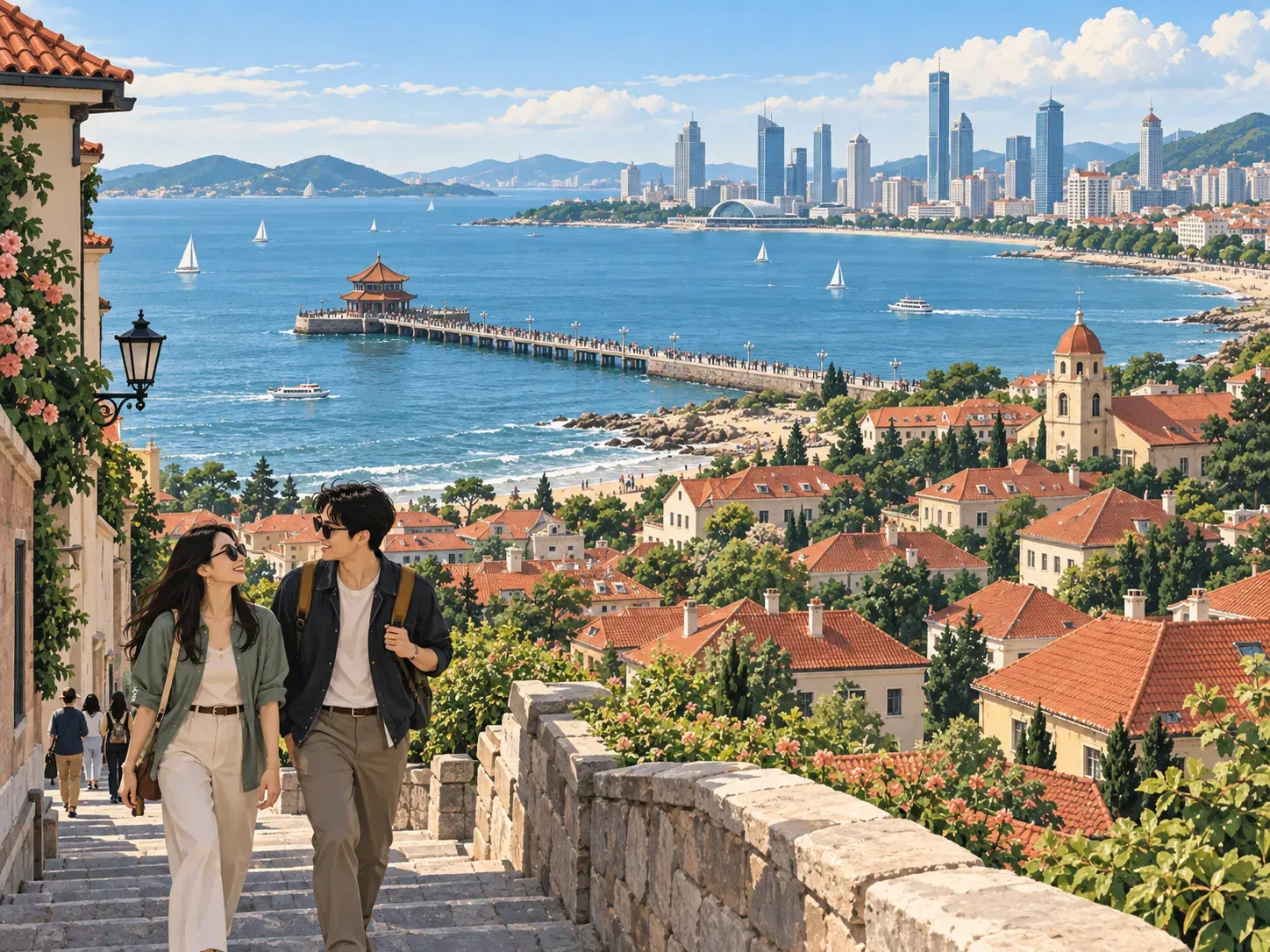
Shandong's coastal city: German colonial-era buildings in the old town, the Zhanqiao pier stretching into Jiaozhou Bay, and Tsingtao Beer — the brand was founded here in 1903 and the brewery is now a museum. Cooler than inland China in summer, walkable, and a useful base for day trips along the coast.
English translations of the source blocks on this page were prepared with machine assistance and are under editorial review; the Chinese source text remains authoritative.
HistoryLandscapeIslands
Where to start
- Qufu's Three Confucian sites
- Mount Tai & the Dai Temple
- Jinan's spring old city
Read these before you plan
- P0Book Mount Tai, Laoshan and the Three Confucian sites before scheduling anything
Both mountains run real-name booking, officially openable 7 days ahead, and the Confucian sites deserve advance confirmation through '文博曲阜' or similar official platforms. Only once dates are held should the Dai Temple, Jinan's springs and the Jiaodong coast slot in — otherwise caps and sellouts can void the core day.
- P0The three cores' minimum times have hit their floor
Mount Tai takes 8–12 hours or a night; Qufu's sites 4–6; Liugong Island 5–7; and Penglai and Laoshan 3–4 each. Below these, queues, transfers and the return eat the actual viewing — with no buffer for weather or closures.
- P0On the Jiaodong coast, base in Qingdao and Weihai — don't move daily
Between Qingdao's old town and Laoshan, sleep in Qingdao; in Weihai prefer the city or Weihai Bay for Liugong and Chengshantou; Penglai and Changdao want another night. The fewer coastal city switches, the better the dawn light and the boat schedules survive.
- P1Give the best light to dawn coasts and sunset water lanes
Badaguan, Liugong's Donghong battery, Changdao's Nine-Cliff and Chengshantou favour early morning or pre-sunset; Taierzhuang's main window runs blue hour into the lamps. Mount Tai's sunrise is planned against the published time — no midnight sprints improvised.
- P1Keep the must-sees few and precise
On Mount Tai: Zhongtianmen–Nantianmen–Jade Emperor Peak. In Qufu: the temple's axis and Dacheng Hall. In Jinan: Baotu Spring and Qushuiting Street. In Qingdao: Badaguan and the Zhanqiao. On Liugong: the Donghong battery; at Penglai: the main pavilion on Dan Cliff. Finish each main line before pricing add-ons.
- P1Read season windows by sea state and weather — publicity photos aren't promises
April–June and September–October are broadly comfortable, yet sea fog, gusts and showers still cap Liugong, Changdao, Chengshantou and Mount Tai, and birding at the Yellow River mouth plus island boats answer to ecology and sea state. Re-verify openings, boats and weather within 24 hours — never risk dawn or sea trips under warnings.
- P2Let official notices override old prices; respect reserves and religious sites
Fares, night sessions, cable cars, boats and free-entry rules move with the seasons — old-guide numbers are references only. Laoshan bans unlicensed drones; the Dai Temple, Lingyan Temple and religious spaces limit shooting; in wetlands and islands stay inside lines, leave the pebbles, don't disturb the migrants.
A · Core landmarks
Start with Shandong's first coordinates
Mount Tai, the Dai Temple, Qufu's three sites, Jinan's springs and Qingdao's old town stand for mountain, ritual, the spring city and the modern coast. A first visit should build the dual Qilu-plus-Jiaodong sense on this layer.
B · Regional depth
From the core coordinates on to the second and third lines
Laoshan, Zibo's Qi culture, Qingzhou, Liugong Island and Penglai push the gaze from Mount Tai toward the eastern-Yi homeland, canal towns and modern sea defence — the second layer of the province's story between central Shandong and the coast.
C · Slow corners
Depth spots for the experienced or the unhurried
Changdao, Chengshantou, the Yellow River mouth, Taierzhuang and Lingyan Temple stand for islands, the coast's end, wetland ecology, the canal and the mountain temple. They don't replace Mount Tai or the coast — they complete Shandong's spatial edges.
Suggested route shapes
- Jinan–Tai’an–Qufu · 4 days
- Zibo Qi culture · 1–2 days
- Qingdao–Weihai–Yantai · 4–5 days
How to save money and time
Rail links the three, but none of their sight lines is short. Suggest 1–2 nights in Jinan for the springs, a night in Tai'an around Mount Tai, and a dedicated 4–6 hours in Qufu — not daily returns from one base to three cores.
Mount Tai is a reference ¥115 in season, ¥100 off, usually 3-day valid and including the Dai Temple. Buying the temple's standalone ¥20 separately is a double spend: once you hold the mountain ticket, slot the temple into the same window. Ticket types and concessions defer to the official booking platform.
Rail between Qingdao, Weihai and Yantai is mature, but moving bags eats hours. Two nights around Qingdao, 1–2 in Weihai reaching toward Rongcheng, then Penglai and Changdao as their own stop; groups can compare charters against buses on short coastal legs.
April–June and September–October are the steadiest bands, but fog, showers and gusts reset Liugong, Changdao, Chengshantou and Mount Tai's ceilings. For sunrise, book refundable or changeable rooms — never prepay a big package on one cloud-sea promise.
The Red Gate night climb starts before dawn — day-time rest is the practical pairing; skipping the climb, staying by the HSR station saves nothing once bus and taxi time goes back in. Qufu and the coast run tight in season: lock refundable rooms 2–4 weeks ahead for the Confucian sites and any sea-sunrise day.
Baotu Spring, the Confucian sites, Liugong and Penglai are the clear-ticket cores; the Qi culture museum, Qingzhou's quarter and Badaguan are mostly free. Inside the big sights, don't stack island rides, submarines, shows and parks on 'we came all this way' — check the clock first.
More in this region
ShanghaiBreak a global city back down into neighbourhoodsJiangsuAlong the canal and the Yangtze, into Jiangsu beyond the Jiangnan clichéZhejiangBeyond Hangzhou: mountains, coast and old villagesAnhuiTwo kinds of China in one province, from Huizhou villages to the northern plainFujianBetween mountains and sea: ports, clans and migration