
Before You Book: 3 Passport and Ticket Checks That Decide Your China Trip
Three ten-minute checks before you book: where you apply for a visa, where your onward ticket takes you, and how long your passport lasts.
The flight was cheap. The hotel was booked. The problem was none of those things. It was a passport date, a ticket home, and a visa filed in the wrong city — three checks that take thirty minutes and save a trip.
She had done everything right, or so she thought. Let us call her Anna, because her story is really three stories stitched together so you can recognise yourself before you become the next version.
Anna found a fare she liked, booked a hotel with free cancellation, and started dreaming about dumplings in Xi'an and a slow morning on West Lake. Then, a week before departure, a friend asked three innocent questions. Where did you apply for your visa? Where does your onward ticket take you? When does your passport expire? Anna laughed at first. Then she checked. Then she stopped laughing.
This article is that friend, earlier. A China trip is not decided by the flight you buy. It is decided by three documents you already own, or do not, and by whether they line up with rules that are stricter and more literal than most travellers expect. Read it before you book anything you cannot refund. If you only have five minutes, skip to the checklist at the end.
For the full, regularly updated guide behind this article, see the HelloChina visas and entry guide: https://hellochina.fans/guides/visas-entry
The mistake most people make
Most people plan a China trip backwards. They start with the cities, the food, the train rides — and treat the visa and the ticket as paperwork to be handled later. That order creates the most expensive surprises, because the paperwork is not paperwork. It is the trip.
A visa is a permission with conditions: where you applied, what you proved, how long your passport lasts, and what you plan to do when you leave. A transit privilege is a different permission entirely, with a different test. A passport is a clock. When any condition fails, the failure rarely appears at the border in China. It appears earlier, at check-in, when the airline will not let you board, or at the visa centre, when the clerk hands your file back.
So we are going to plan forwards. Three checks, each ending with a test you can run in under ten minutes.
Check 1: Where you apply — the third-country trap
Anna's first problem was geography. She was not at home. She was living abroad for a year, working on a contract, and it seemed obvious to apply for her China visa from the city where she was living. Why fly home to file a form?
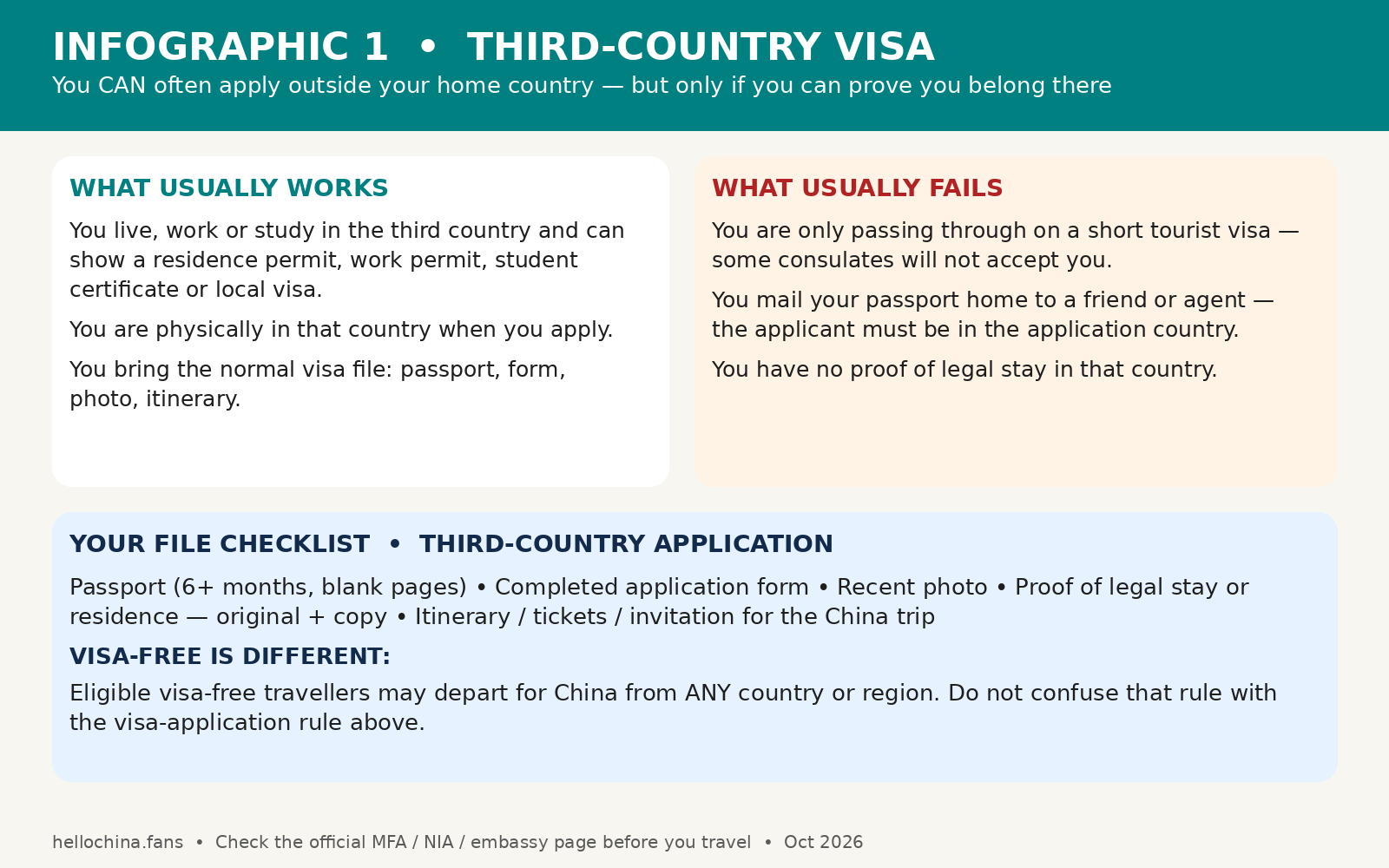
Often, you can apply outside your home country. That is the good news, and it is real. The bad news is that "often" hides a condition that trips up exactly the people who assume it does not apply to them: you usually have to prove that you legally live, work, or study in the country where you are applying.
A consulate does not only ask who you are and why you want to visit China. When you apply outside your citizenship country, it also asks why you are here — and whether you can prove it with a residence permit, work permit, student certificate, or local visa (original and copy). A hotel booking is not proof, and some consulates do not accept short-term tourists at all.
That distinction matters most for long-term travellers hopping between countries, for expatriates whose residence permit is still being processed, and for anyone tempted to solve the problem by post. In all three cases, do not assume — ask the specific consulate first, in plain language, whether it will accept you and what proof of stay it requires.
The third is the person who tries to solve the problem by post. A friend at home offers to file for you. An agent offers to courier your passport back and forth. Do not do it. The applicant is required to be physically in the country where the application is made. A passport mailed home to a friend or agent, filed while you are somewhere else, is not a clever workaround. It is a file built on a fact that is not true, and it will fail when it matters.
Here is the usual third-country file: passport (6+ months, blank pages), completed form with a recent compliant photo, proof of legal stay (original and copy), and trip support — itinerary, tickets, or invitation. Former Chinese citizens with a new foreign passport should also expect to show the previous passport or visas, and a name-change document if applicable.
Now, the distinction that saves the most confusion: visa-free entry is a different rule. If you are eligible for visa-free entry into China, you may depart for China from any country or region. That is the consulate's own answer, given in the visa-free FAQ. It does not mean you can apply for a visa from any country. Visa-free travel and visa application are two doors, with two different keys. Do not use the key from one door on the other.
Before you book anything, run this test. Write down three things: your citizenship, the country where you will apply, and the exact document that proves your legal stay there. If the third line is blank, you do not have a plan yet. You have a hope. Fix the third line first.
Check 2: Where you fly next — the onward-ticket test
Anna's second problem was a ticket home. She had a return flight. That sounds like the responsible thing to have. For one specific kind of entry — 240-hour visa-free transit — a return flight to where you came from is precisely the ticket that fails.
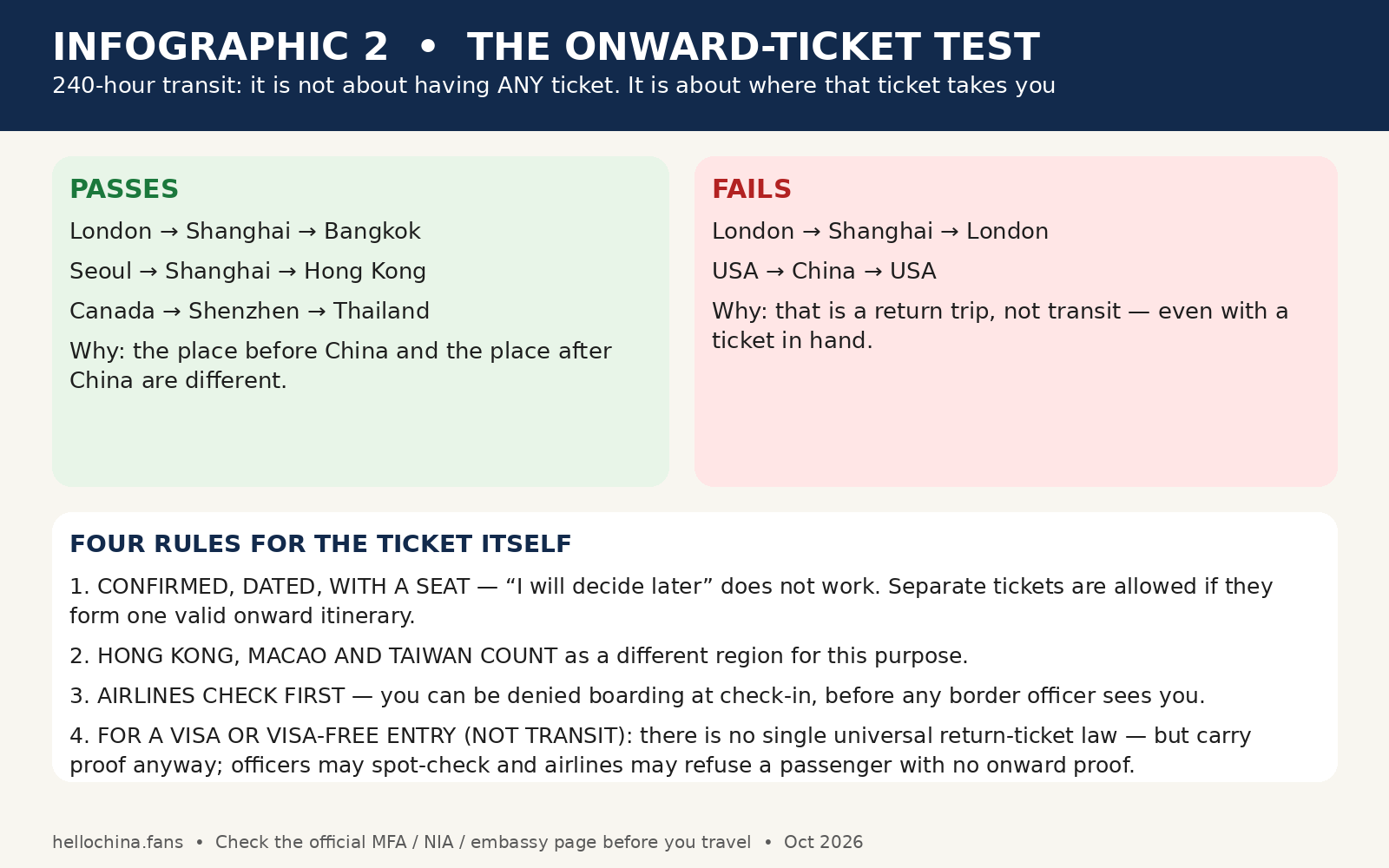
The 240-hour transit policy is not a general visa waiver. It is a transit permission. Its test is simple, and it is literal: you must be travelling through China to a third country or region. The place you come from and the place you go to next must be different. London to Shanghai to London does not qualify, even with a ticket in hand. London to Shanghai to Bangkok does. The United States to China and back to the United States does not qualify. The United States to China and onward to South Korea does.
Hong Kong, Macao, and Taiwan count as a different region for this purpose. That single sentence rescues a huge number of real itineraries. Seoul to Shanghai to Hong Kong works. Canada to Shenzhen to Thailand works. A traveller who enters the mainland and leaves via Hong Kong is travelling onward, not returning, in the eyes of the policy. What does not work is treating a stop in a third place as a technicality. The test looks at the leg into China and the leg out of China. Those two places must belong to different countries or regions. A route that goes Bangkok to Shanghai to Bangkok fails for the same reason a round trip fails: the immediate neighbours are the same place.
Then there is the ticket itself. It must be confirmed, dated, and seated — a real onward ticket to that third country or region, within the 240-hour window. "I will decide later" does not work. A screenshot of a search result does not work. A booking you intend to make after you arrive does not work. Separate tickets are allowed, so long as together they form one valid onward itinerary, but you must hold them and be able to show them. And here is the part most guides bury: the airline checks first. You can be denied boarding at check-in, in your departure city, long before any border officer in China sees your documents. The officer is the second check, not the first. If your ticket fails the third-country test, you may never get on the plane to find out.
The clock is kinder than most people fear, if you count it correctly: the 240 hours run from midnight on the day after you enter, not from the minute you land. Plan from the dates on your temporary entry permit, and depart before it expires. A miscount is an overstay.
Now, what about travellers who are not using transit at all? If you hold a visa, or if you are entering visa-free under the 30-day policy, there is no single universal return-ticket law that works the same way in every case. That is important to say plainly, because a lot of advice online pretends otherwise. What is true is narrower, and more practical: border officers may spot-check your purpose of visit, and they may ask to see tickets, hotel reservations, or an invitation that matches that purpose. Airlines, separately, may refuse a passenger who cannot show onward proof, because the airline faces consequences if it carries someone who is refused entry. So the practical rule for visa and visa-free travellers is the same as the legal rule for transit travellers, just softer in wording: carry proof anyway. A confirmed onward or return booking, hotel reservations that match your itinerary, and an invitation if you are staying with someone — printed or easily shown on your phone, in a folder you can open without hunting through email at the counter.
For an L visa application, an itinerary and round-trip tickets are standard supporting documents — they show the trip you describe is the trip you planned.
Run this test before you pay. Write down your three places in order: where you fly from, where you enter China, where you fly to next. If the first and third places are the same country or region, and you are relying on 240-hour transit, stop. You need a different third place, or a different permission — a visa, or a visa-free entry you actually qualify for. If you are relying on a visa or visa-free entry, write down the onward proof you will carry. If that line is blank, fill it before you book the non-refundable part.
Check 3: How long your passport lasts — two rules, do not mix them
Anna's third problem was the quietest, and therefore the most dangerous. Her passport was valid. It would still be valid on the day she flew home. It just did not have six months left on it.
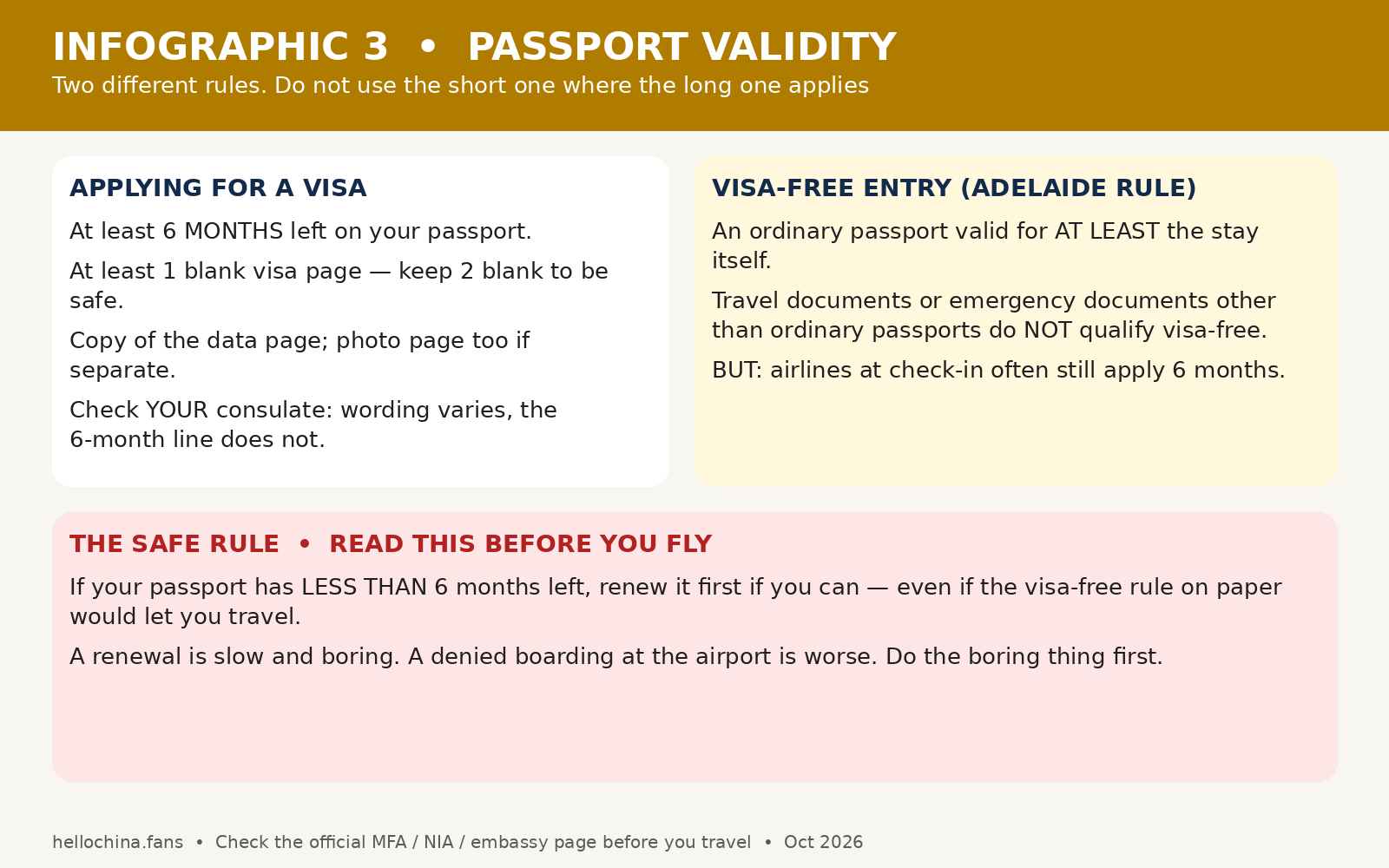
For a visa application, the rule most consulates state is: an original signed passport with at least six months of remaining validity and blank visa pages, plus a copy of the data page and the photo page if it is separate. Some guides say two blank pages to be safe. That is good advice, and it matches the way many centres actually work: one page for the visa sticker itself, and a second page so that entry and exit stamps do not collide with it. Do not treat "blank" as "mostly empty." A page with a small stamp on it is not blank. A page that is blank today but will hold a visa for another country next month is not blank for China.
For visa-free entry, the rule on paper is shorter, and this is where travellers get confused. The Chinese Consulate-General in Adelaide, in its visa-free FAQ, states it plainly: a foreign national needs an ordinary passport valid for at least the duration of the intended stay in China. Holders of travel documents or temporary or emergency documents other than ordinary passports are not allowed to enter without a visa. Read literally, that means a passport with, say, four months left could cover a two-week visa-free trip.
Do not stop reading there. Airlines at check-in often apply a six-month rule of their own, regardless of what the destination's visa-free FAQ says. That is not a contradiction. It is two different gatekeepers applying two different standards. The border officer applies the visa-free rule. The airline applies its own boarding rule, shaped by the fines and return costs it faces if it carries someone who is refused. If your passport has less than six months left, you can be right about the visa-free rule and still be denied boarding. Being right is not the same as getting on the plane.
So here is the safe rule, and it is deliberately boring: if your passport has less than six months left, renew it first if you possibly can, even if the visa-free rule on paper would let you travel. A renewal is slow. A denied boarding is worse, and it happens in public, at the worst possible moment, with a non-refundable trip behind it. If renewal is genuinely impossible, call the airline in advance with your exact dates and keep a note of the conversation. Hope is not a document.
Also check the physical passport: signed, data page undamaged, and enough genuinely blank pages for this visa and every stamp on the journey — not just China. A technically valid but physically full passport is full.
Run this test now. Open your passport. Read the expiry date out loud. Count the months to your return date, not your departure date. Count the blank pages by turning them, not by guessing. If either number is tight, the passport is the first thing to fix, before the flight, before the hotel, before the visa form.
The thirty-minute routine, in order
Tonight, with a cup of tea, do three ten-minute tests before you spend another dollar. First, write down your citizenship, where you will apply for a visa if you need one, and the document proving your legal stay there — or, if you need no visa, which permission you rely on and why you qualify. Second, write down your three places — from, through China, to — and confirm your onward proof. Third, open your passport, count months to your return date and count blank pages by turning them, not guessing. Only then book the non-refundable parts. That order feels slow. It is the fastest order, because it is the only one that does not end with rebooking.
Frequently asked questions
Can I apply for a Chinese visa in a country that is not my home country? Generally yes, but you will usually need to prove legal stay or residence in that country — a residence permit, work permit, student certificate, or local visa, original and copy. Some consulates do not accept applications from short-term tourists in that country. Ask the specific consulate before you travel to file there, and be physically present in that country when you apply. Mailing your passport home for someone else to file does not work, because the applicant must be in the application country.
Can I enter China visa-free if I depart from a third country? If you are eligible for visa-free entry, yes. The Adelaide consulate's FAQ states that eligible foreign nationals can depart for China from any country or region. That is a visa-free rule. It is not the same as the visa-application rule above, which does require proof of stay where you apply.
Does a return flight home qualify for 240-hour visa-free transit? No. The policy requires onward travel to a third country or region. The place you arrive from and the place you depart to must be different. A return to your starting country or region is a round trip, not transit, and it will fail even if you hold a ticket. Hong Kong, Macao, and Taiwan count as a different region for this purpose.
Does my onward ticket have to be on the same airline or booking? No. Separate tickets are acceptable, so long as together they form a valid onward itinerary with a confirmed date and seat to a third country or region within the window. You must be able to show them at check-in and on arrival. The airline checks at check-in, not only the border officer on arrival.
How much passport validity do I need for a Chinese visa? Generally at least six months of remaining validity and blank visa pages — keep two blank pages to be safe — plus a copy of the data page. Exact wording varies by consulate, so check your consulate's page, but the six-month line is consistent across the major missions.
How much passport validity do I need for visa-free entry? On paper, under the Adelaide consulate's FAQ, an ordinary passport valid for at least the duration of your intended stay. In practice, airlines at check-in often still apply six months. If your passport has less than six months left, renew first if you can. If you cannot, contact the airline in advance with your exact dates and keep a note of the conversation.
I hold a visa / I am entering visa-free. Do I need a return ticket? There is no single universal return-ticket law that covers every visa and visa-free case in the same way. Carry proof anyway: a confirmed onward or return booking, hotel reservations that match your itinerary, and an invitation if you are staying with someone. Border officers may spot-check your purpose of visit, and airlines may refuse a passenger who cannot show onward proof.
The last word
Anna, in the end, did three unglamorous things: she waited for her residence permit, changed her onward ticket to Bangkok instead of home, and renewed her passport. Your trip deserves the same boring beginning. Check where you apply, where you fly next, and how long your passport lasts — before you book — and the rest gets to be the fun part.
This article is general information, not legal or consular advice. Visa and entry rules vary by nationality, consulate, and port, and they change. Before you travel, check the official page of the Chinese embassy or consulate for your jurisdiction, the National Immigration Administration, and your airline. If any detail in this article conflicts with an official source, the official source wins.
Read the full guide: https://hellochina.fans/guides/visas-entry