
China 10-Day Visa-Free Transit: The 240-Hour Rule Explained (2026)
China 10 Day Visa Free Transit: The 240 Hour Rule Explained 2026 Key Takeaways China's 240 hour visa free transit allows citizens of roughly 57 countries to pass through China with
China 10-Day Visa-Free Transit: The 240-Hour Rule Explained (2026)
Key Takeaways
- China's 240-hour visa-free transit allows citizens of 57 countries (National Immigration Administration list, August 2026) to pass through China without a visa for up to 10 days, provided they are travelling on to a third country or region.
- The 240-hour clock starts at 00:00 on the day after you enter, so a late-evening arrival effectively gives you close to 11 calendar days on the ground.
- You must enter through one of 60 designated ports and remain inside the province or regional cluster assigned to that port. There is no application form, no fee, and no advance approval.
- The exemption is decided by the immigration officer at the border, so your documents — passport and confirmed onward ticket — must be in order before you board the flight.
- Before relying on the transit rule, check whether your nationality now qualifies for China's broader 30-day unilateral visa-free entry, which is simpler and has fewer geographic restrictions.
1. Introduction
China's border rules changed more between 2024 and 2026 than in the previous decade. The 240-hour visa-free transit policy, introduced in December 2024 as an expansion of the earlier 72- and 144-hour schemes, turned the country's major hubs into genuinely usable stopover destinations. Ten days is enough to see Beijing and Xi'an, or Shanghai and the water towns of the Yangtze Delta, without paying for a tourist visa or waiting on a consular appointment.
The confusion is not about whether the policy exists — it does — but about who it applies to and how the clock actually works. Three questions come up again and again: Does my route count as "transit"? Where am I allowed to travel once I'm in? And how do the 240 hours get counted? Travellers regularly book flights assuming they qualify, then discover at check-in that a return trip to their home country does not meet the third-country requirement.
This guide explains the mechanics of the 240-hour rule in plain terms, with worked examples for common routes, the geographic limits that catch people out, and a step-by-step walkthrough of what happens at the airport. It is written for independent travellers planning a China stopover in 2026, and it flags where you should verify details directly, because eligibility lists and port designations are revised periodically.
2. What the 240-Hour Rule Actually Is
The core point: this is a transit exemption, not a visa. You are not being granted permission to visit China as a destination; you are being allowed to pass through it while travelling between two other places. Everything else about the policy follows from that framing.
The mechanics are straightforward:
- Duration: up to 240 hours (10 days) in mainland China.
- Cost: none. There is no application, no fee and no pre-approval process.
- Where it is decided: at the port of entry, by the immigration officer, on the basis of your passport and your onward booking.
- What it permits: tourism, visiting relatives and friends, and business activities such as meetings, negotiations and exhibitions.
- What it prohibits: employment, study, and any activity requiring a residence permit. Overstaying is treated as a visa violation and carries fines and possible detention.
The third-country rule is the part that decides most cases. You must be travelling from Country A, through China, to Country C — where C is neither your origin nor, in practical terms, a return to your starting point. A confirmed onward ticket with a departure date inside the 240-hour window is the evidence immigration officers look for.
| Route | Qualifies? | Why |
|---|---|---|
| London → Shanghai → Tokyo | Yes | Genuine A→China→C routing |
| New York → Beijing → Bangkok | Yes | Genuine A→China→C routing |
| Sydney → Guangzhou → Hong Kong | Yes | Hong Kong counts as a separate third region |
| Paris → Shanghai → Paris | No | Returning to origin; not a transit |
| Toronto → Beijing → Vancouver | No | Same country on both sides of the trip |
| Singapore → Chengdu → Singapore | No | Round trip to origin |
Two practical notes follow from this. First, Hong Kong, Macau and Taiwan are treated as third regions for transit purposes, which makes routings like "San Francisco → Shanghai → Hong Kong" a legitimate and popular way to use the policy. Second, the onward leg must be booked and confirmed, not merely intended — a reservation on hold, or an open ticket without a date, is a common reason for refusal at check-in.
3. Who Qualifies, Where You Can Go, and How the Clock Runs
Eligible nationalities
As of the National Immigration Administration's August 2026 list, 57 countries are covered. They are concentrated in Europe — most EU member states plus the United Kingdom, Switzerland, Norway, Iceland, Russia, Serbia and several Balkan countries — alongside the United States, Canada, Brazil, Mexico, Argentina, Chile, Australia, New Zealand, Japan, South Korea, Singapore, Brunei, the United Arab Emirates and Qatar.
The list is revised periodically, usually in the direction of expansion. Check China's National Immigration Administration announcements, or your airline's travel-document tool, close to your departure date rather than relying on a blog post from last year.
Designated ports and permitted regions
You must enter through one of the 60 designated ports, spread across 24 provincial-level regions. The permitted stay area is tied to your entry port, and in many cases it covers a cluster of neighbouring provinces rather than a single city:
- Beijing and Tianjin typically allow travel across Beijing, Tianjin and Hebei.
- Shanghai typically covers Shanghai, Jiangsu, Zhejiang and Anhui — the Yangtze River Delta cluster.
- Guangzhou and Shenzhen typically cover Guangdong province.
- Chengdu, Xi'an, Kunming and Hainan each have their own defined areas, with Hainan covering the whole island.
Read the specific permitted area for your arrival port before you book internal flights or high-speed rail. A traveller who lands in Shanghai and then books a flight to Beijing has left the permitted region, even though both cities are on the transit list.
How the 240 hours are counted
The clock starts at 00:00 on the day following your entry, not at the moment you clear immigration. This is a meaningful detail:
- Arrive at 22:00 on Monday, and the 240 hours begin at 00:00 on Tuesday, running to 00:00 on the following Friday week — nearly eleven days of usable time.
- Arrive at 08:00 on Monday, and you have the full Monday plus ten more days.
Your departure must fall inside that window. The exemption cannot be extended, and you cannot leave China and re-enter to reset it.
4. Step by Step: Using the Policy at the Airport
Conclusion first: the transit rule is reliable when your paperwork is unambiguous. Most failures happen at the airline check-in desk, not at Chinese immigration, because ground staff are liable for passengers they board incorrectly and tend to apply the rules conservatively.
- Confirm your nationality is on the list and that your route is a genuine A→China→C itinerary with a confirmed onward booking.
- Check your passport validity. It must cover your stay; airlines commonly apply a six-month validity convention, so verify with your carrier if you are close to expiry.
- Print your documents. A paper copy of the confirmed onward ticket, your hotel booking and the policy summary is still the fastest way to resolve a confused check-in agent.
- At check-in, state your intention clearly. Say "240-hour visa-free transit" and show the onward ticket. Some airlines' systems do not automatically recognise the exemption and require a manual override.
- On arrival, follow the transit/visa-free signs rather than the standard immigration queues. You will complete an arrival card and, in most ports, a dedicated transit form.
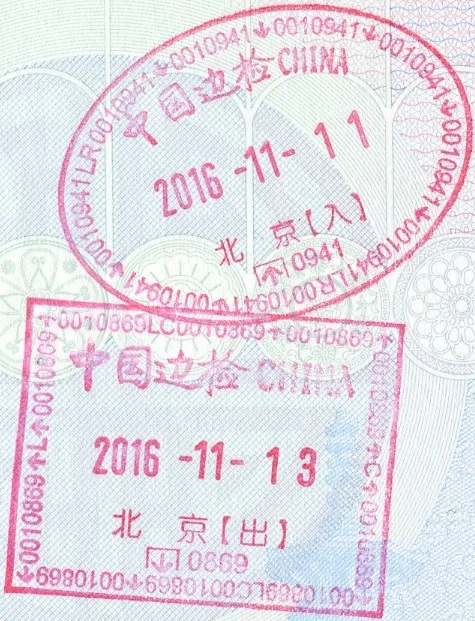
- Receive your stay permit. The officer will stamp or annotate your entry with the permitted area and the deadline. Check the date on it before you leave the counter.
- Register your accommodation. Hotels register foreign guests automatically. If you stay in a private home or a short-let that does not, you are generally required to register with the local police station within 24 hours.
- Leave from a designated port before your deadline, allowing buffer time for delays.
5. Comparison and Common Pitfalls
| 240-hour visa-free transit | 30-day unilateral visa-free | Tourist (L) visa | |
|---|---|---|---|
| Purpose | Transit to a third country | Tourism, business, family visits | Tourism |
| Duration | Up to 240 hours | Typically 30 days per entry | Usually 30–90 days, single or multiple entry |
| Application | None — decided at the border | None — decided at the border | Required in advance |
| Third-country requirement | Yes | No | No |
| Geographic limits | Yes — restricted to the region of entry | No — nationwide | No — nationwide |
| Extension possible | No | Limited, case by case | Yes, at a local exit-entry bureau |
| Typical users | US, UK, Canadian and other nationals not covered by broader schemes | nationals of the 40+ countries on the unilateral list | Longer stays, other purposes |
Five pitfalls worth flagging:
- Assuming the 30-day scheme covers you. The United States, the United Kingdom, Canada and India are not on China's unilateral visa-free list, which is precisely why the transit rule matters for those passports.
- Booking a same-country return. The single most common disqualifier.
- Ignoring the regional boundary. Domestic flights and rail are easy to book, which makes it easy to wander outside your permitted area without realising.
- Cutting the departure deadline close. A cancelled flight on day ten leaves you in overstay territory; keep a day of slack.
- Relying on a hold, not a ticket. An unconfirmed onward booking is not sufficient evidence of transit.
6. FAQ
Q1. Do I need a visa for a 10-day stopover if I fly London → Beijing → Bangkok?
No. That is a textbook qualifying route: you are a UK national travelling from one country to another via China, holding a confirmed onward ticket departing within 240 hours. You will be admitted visa-free at a designated port, subject to the permitted area for that port.
Q2. Can I extend the 240 hours, or leave and re-enter to start again?
No. The exemption is fixed at 240 hours and cannot be extended at a local exit-entry bureau. Leaving mainland China ends the permit; re-entry requires a fresh qualifying transit itinerary or a different entry basis, and immigration officers assess repeat use case by case.
Q3. Can I attend business meetings on the 240-hour transit?
Yes. Business visits, meetings, negotiations and trade exhibitions are within the permitted activities. Paid employment, study programmes and anything requiring a residence permit are not.
Q4. Which is better for me — the 240-hour transit or the 30-day visa-free entry?
If your nationality is on the 30-day unilateral visa-free list, use that: it has no third-country requirement and lets you travel anywhere in China. The 240-hour transit is the better fit for nationals of countries such as the United States, the United Kingdom and Canada who want a stopover of up to ten days en route to somewhere else, and who can work within the regional boundary.
7. Conclusion
The 240-hour visa-free transit is one of the most useful — and most misunderstood — entry routes into China. Treat it as a stopover privilege rather than a visa, and three rules determine everything: your itinerary must genuinely continue to a third country or region, your arrival must be at a designated port with a defined permitted area, and your departure must fall inside the 240-hour window that begins the day after you land.
For travellers from countries outside China's broader visa-free arrangements, this is the most practical way to add Beijing, Shanghai, Chengdu or Xi'an to a longer Asian trip without consular paperwork. The preparation required is modest: a confirmed onward ticket, a passport with sufficient validity, printed documentation for the check-in desk, and an itinerary that respects the regional boundary attached to your arrival port.
Because eligibility lists, port designations and permitted areas are updated several times a year, confirm the current details with China's National Immigration Administration or your airline shortly before departure. The HelloChina editorial team tracks entry-policy changes and practical travel logistics for international readers, and this guide will be revised as the rules evolve.