
China High-Speed Rail for Tourists: Classes, Luggage Rules and Station Navigation
China High Speed Rail for Tourists: Classes, Luggage Rules and Station Navigation Key Takeaways China's high speed network CRH and Fuxing trains, marketed as G, D and C services is
China High-Speed Rail for Tourists: Classes, Luggage Rules and Station Navigation
Key Takeaways
- China's high-speed network (CRH and Fuxing trains, marketed as G, D and C services) is the default way to travel between major cities; it is fast, punctual and easier for foreign visitors than it was a few years ago, but the station process is not self-explanatory on a first trip.
- There are three main seat classes on daytime high-speed trains: Second Class (3+2 seating), First Class (2+2), and Business Class (1+2 or 1+1, sometimes lie-flat). First Class typically costs roughly 1.6 times Second Class, and Business Class roughly three times.
- The free luggage allowance is generous by international standards — about 20 kg per adult, with each piece limited to roughly 130 cm in total dimensions on high-speed trains — but there is no checked baggage on most services, so you carry everything yourself.
- Arrive 45–60 minutes before departure at a large station. Security check, ticket check with your passport, and finding the right waiting area and platform all take longer than the train ride itself on short hops.
- The single most useful preparation is booking through the official 12306 app (which has an English interface) and keeping your passport with you at every step, from station entry to seat.
1. Introduction
For most international visitors, the moment China's high-speed rail stops being an abstraction is the first station. The train itself is quiet, clean and often faster than flying once you count airport transfers. The difficulty is everything around it: which of the four station entrances you should use, whether your suitcase will fit, why the gate closed four minutes before departure, and what "First Class" actually buys you.
This guide is written for travelers who have already decided to take the train and now need the practical layer — seat classes compared honestly, luggage rules explained with the real-world constraints that matter, and a step-by-step walkthrough of station navigation so the first trip is predictable rather than improvised. The HelloChina editorial team writes these guides in English for international readers rather than translating domestic Chinese travel content, because the questions a first-time visitor asks are different from the ones a local commuter asks.
By the end, you should be able to choose a class with confidence, pack for the allowance, and move through a Chinese railway station without needing to ask for help — though staff at major stations are generally used to assisting foreign passengers.
2. Seat Classes: What You Actually Pay For
Core conclusion: Choose Second Class unless the trip is longer than about four hours or you are traveling with large luggage and want easier access; the incremental comfort of First Class is real but modest, and Business Class is best justified on long daytime runs or overnight high-speed sleepers.
Chinese high-speed trains sell seats in tiers, and the naming is literal. On a typical G-series train:
| Class | Layout | Typical price vs. Second Class | Best suited to |
|---|---|---|---|
| Second Class (二等座) | 3+2, five seats per row | Baseline | Short and medium trips, budget travelers, families |
| First Class (一等座) | 2+2, four seats per row | Roughly 1.6× | Trips over 4 hours, taller or larger travelers, working on board |
| Business Class (商务座) | 1+2 or 1+1, wide reclining seats | Roughly 3× | Long daytime journeys, overnight high-speed services, travelers who value quiet |
| Sleeper classes (on overnight high-speed trains) | Private or semi-private berths | Varies by route | Overnight routes where you want to arrive rested |
Second Class is not cramped by economy-airline standards — seat pitch is comparable to short-haul premium economy, rows recline, most modern carriages have power outlets, and there is a fold-down table. The real difference is density: five seats across means more foot traffic in the aisle and less elbow room.
First Class adds width, a center armrest, more recline, and a 2+2 layout that noticeably reduces the number of people sharing overhead space. On a four-hour-plus journey, that translates into being able to work or sleep. On a 40-minute hop between, say, Suzhou and Shanghai, it is money spent on very little.
Business Class varies more than the other two. On newer Fuxing trains, seats recline close to flat and may include a small privacy shell, a reading light, and attendant service; on older equipment the difference is smaller. Because the price multiple is steep, treat it as a comfort purchase rather than a speed purchase — the train leaves at the same time either way.
Practical advice: If you are unsure, book Second Class for anything under three hours and First Class for longer daytime trips. If you are traveling with a 28-inch suitcase and no desire to wrestle it into an overhead rack, First Class also gives you slightly more room to maneuver — though the end-of-carriage luggage racks are usually the better answer regardless of class.
3. Luggage Rules: The Written Limits and the Real Ones
Core conclusion: The free allowance is unlikely to be your constraint; physical storage space is. Pack one manageable suitcase plus a backpack, and you will almost never have a problem.
China Railway's rules for high-speed trains are straightforward and rarely enforced with a scale, but they do exist:
| Rule | High-speed trains (G/D/C) | Notes |
|---|---|---|
| Free allowance per adult | About 20 kg | Children around 10 kg; infants' necessities excluded |
| Free allowance per piece | Total dimensions (length + width + height) around 130 cm | Conventional slower trains allow up to about 160 cm |
| Checked baggage | Generally not available on high-speed services | Use station luggage counters or courier services for oversized items |
| Prohibited items | Weapons, flammables, explosives, strong-smelling or hazardous goods | Scissors, knives and tools above small blade limits are confiscated at security |
| Restricted items | Aerosols and alcohol-based liquids in limited quantities; lighters capped at two | Rules are updated periodically, so check before packing |
| Power banks | Must be clearly labeled with capacity; very high-capacity units may be refused | Carry them in hand luggage, not checked or couriered |
| Smoking | Prohibited on all trains, including e-cigarettes | This is enforced strictly |
Storage on board works in three layers. Overhead racks above your seat fit carry-on bags and backpacks and, in most carriages, a 24-inch suitcase at a squeeze. Larger cases go in the racks at the ends of each carriage, next to the doors — these fill up first on busy trains, so board early if you have a big case. Smaller items can go under the seat in front of you. There are no lockers, no baggage carousels, and no staff to handle your bags.
Two practical cautions follow. First, security screening at station entrances works like an airport checkpoint minus the liquids limit: bags go through a scanner, and anything questionable is opened and inspected. Leave room in your packing so repacking is not a spectacle. Second, if you are carrying something genuinely bulky — skis, a large instrument, a folding bike — use a station luggage counter or a courier service rather than testing the conductor's patience.
Scenario advice: For a two-week trip with a 28-inch case and a daypack, you have two options. Either book First Class on long legs for the extra room, or use left-luggage counters (available at most major stations) and travel lighter between bases, shipping the large case ahead by courier. The second approach is what many repeat visitors settle into.
4. Station Navigation: A Step-by-Step Walkthrough
Core conclusion: Chinese railway stations are large but highly systematic. Follow the sequence below and the process takes about 25 minutes at a major hub — which is why arriving 45–60 minutes early is comfortable rather than excessive.
- Confirm your station, not just your city. Large cities have multiple stations: Beijing has Beijing South, Beijing West, Beijing Chaoyang and others; Shanghai has Hongqiao and Shanghai Station. Your ticket names the station, and they are far apart. Check the station name the night before.
- Enter through the correct square. Stations often have East, West, North and South entrances. Your ticket or booking app may indicate one; if not, any entrance with a security line works, but the entrance closest to your waiting area saves a long indoor walk.
- Pass security. Place bags on the scanner belt, walk through the metal detector, and collect your bags. Keep your passport accessible.
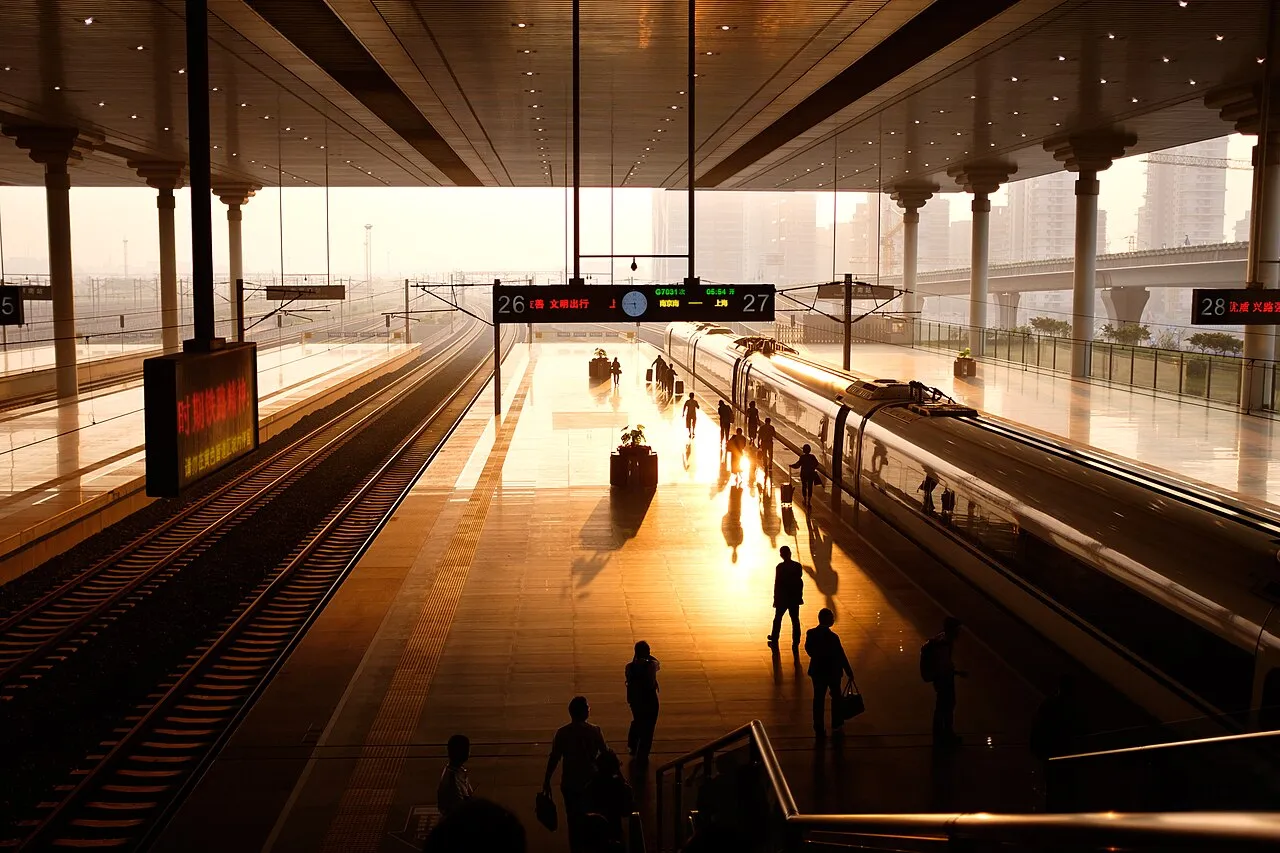
- Reach the departure hall. Follow signs for the waiting area (usually upstairs or on the main concourse). Large screens list trains by number, departure time, and gate — find your train number, not the destination name, which may appear in Chinese only.
- Wait near your gate, then watch the boarding call. Ticket gates typically open 15–20 minutes before departure and close about 5 minutes before it. The call is announced in Chinese and often English on major routes; the screens are the reliable source.
- Scan in with your passport. Insert or tap your passport at the gate. Foreign passports work at most automatic gates now, but allow a manual check if the reader rejects it — staff are stationed at every gate bank.
- Find your carriage on the platform. Carriage numbers are marked on the platform floor and on the train doors. Walk to your carriage number before boarding; moving between carriages inside the train is possible but awkward with luggage.
- Store your bag, take your seat, and keep your ticket accessible. Conductors may check tickets once after departure.
| Timing checkpoint | Recommendation |
|---|---|
| Arrive at station | 45–60 minutes before departure at large hubs; 30 minutes at small stations |
| Clear security | Usually 5–15 minutes, longer on Friday evenings and around public holidays |
| Boarding gate closes | About 5 minutes before departure — do not plan to arrive at this point |
| Ticket sales window | Roughly 15 days in advance; popular routes and holiday dates sell out fast |
Ticketing note: The official 12306 app has an English interface and accepts international passports and major foreign cards, though payment can occasionally be finicky. Third-party platforms are easier to use but add booking fees and can complicate changes and refunds. Refunds follow a tiered schedule that gets more expensive as departure approaches, while changing to another train on the same route is usually simpler than cancelling.
5. Key Considerations Before You Book
- Trip length drives class choice. Under three hours, Second Class is fine. Three to five hours, First Class earns its premium. Beyond five hours, or overnight, consider Business Class or a sleeper service.
- Peak dates change everything. Around Spring Festival, the May holidays and the National Day week in early October, trains sell out within minutes of the sales window opening and stations are genuinely crowded. Book the moment tickets release and add buffer time at the station.
- Short hops are the sweet spot. A 30–60 minute ride between neighboring cities costs less than a taxi across a major city and requires no airport transfer — but the station process can take as long as the journey, so do not over-schedule multiple short legs in one day.
- Food and drink. Trolley service and a dining car exist on most long-distance trains; ordering delivery to your seat via the 12306 app at a station stop is a popular local habit. Bringing your own snacks and a refillable bottle (hot water dispensers are in every carriage) is the simplest plan.
- Language. Station signage at major hubs includes English; smaller stations may not. Photograph your train number and carriage number, and show the screen to staff if you need directions.
6. FAQ
Q1. Do I need to print my ticket?
No. Since the shift to e-tickets, your passport is your ticket. Scan it at the gate, and keep it with you on board in case a conductor checks. Printed receipts are available at counters but are not required for travel.
Q2. Can I bring a large suitcase on a Chinese high-speed train?
Yes, provided it fits the allowance — roughly 130 cm total dimensions and about 20 kg per adult. In practice, a 28-inch case is accepted but will usually need the luggage rack at the end of the carriage rather than the overhead rack. Board early on busy trains, as those racks fill quickly.
Q3. Is First Class worth the extra cost?
For journeys over about four hours, generally yes: the 2+2 layout, wider seat and quieter carriage make working or sleeping realistic. For short intercity hops, the difference is small and Second Class is the better value.
Q4. How early should I arrive at the station?
Forty-five to sixty minutes before departure at a large station, thirty minutes at a smaller one. Security and finding your gate are the slow parts, and gates close about five minutes before the train leaves. During public holidays, add another twenty to thirty minutes.
7. Conclusion
China's high-speed rail rewards a small amount of preparation. The system itself is reliable and remarkably punctual; what trips up first-time visitors is the surrounding process — the wrong station, a suitcase that does not fit the rack, a gate that closed while they were still looking for the platform.
The short version: book early through 12306, choose Second Class for short hops and First Class for longer daytime legs, pack one case you can lift yourself, and arrive at the station an hour ahead with your passport in hand. Do that, and the train becomes the easiest part of the trip rather than the most stressful.
For more practical, English-language guidance on traveling in China — visas and entry, itineraries, food, culture and safety — see the destination guides at HelloChina (hellochina.fans), where content is produced by the editorial team with AI-assisted drafting and human review.