
No Heat, No AC: China's October-November Hotel Gap — and How to Avoid a Cold Night
Northern hotels can sit between cooling and heating in late October and early November. Ask one date-specific question before you book, and pack one warm indoor layer.
Picture this. You land in Beijing in late October, golden leaves everywhere, the air sharp and perfect for walking. You check into a good hotel, drop your bag, and go out for lamb hotpot and a night walk along the lakes. You come back tired and happy, you shower, you climb into bed — and the room is cold. Not dramatic, not freezing, just stubbornly cool. You find the wall panel and press the heat button. Nothing happens. You try the air-conditioning control. Nothing happens either. You call reception, and the answer, politely delivered, is the sentence that ruins a lot of first trips to China in autumn: the system is between seasons.
Welcome to the hotel gap. It is not a scam, and it is not something most booking sites warn you about. It is what happens when a country that heats whole cities on a calendar meets a traveler who arrives on the wrong week of that calendar. Once you understand it, it is almost entirely avoidable.
What the gap actually is
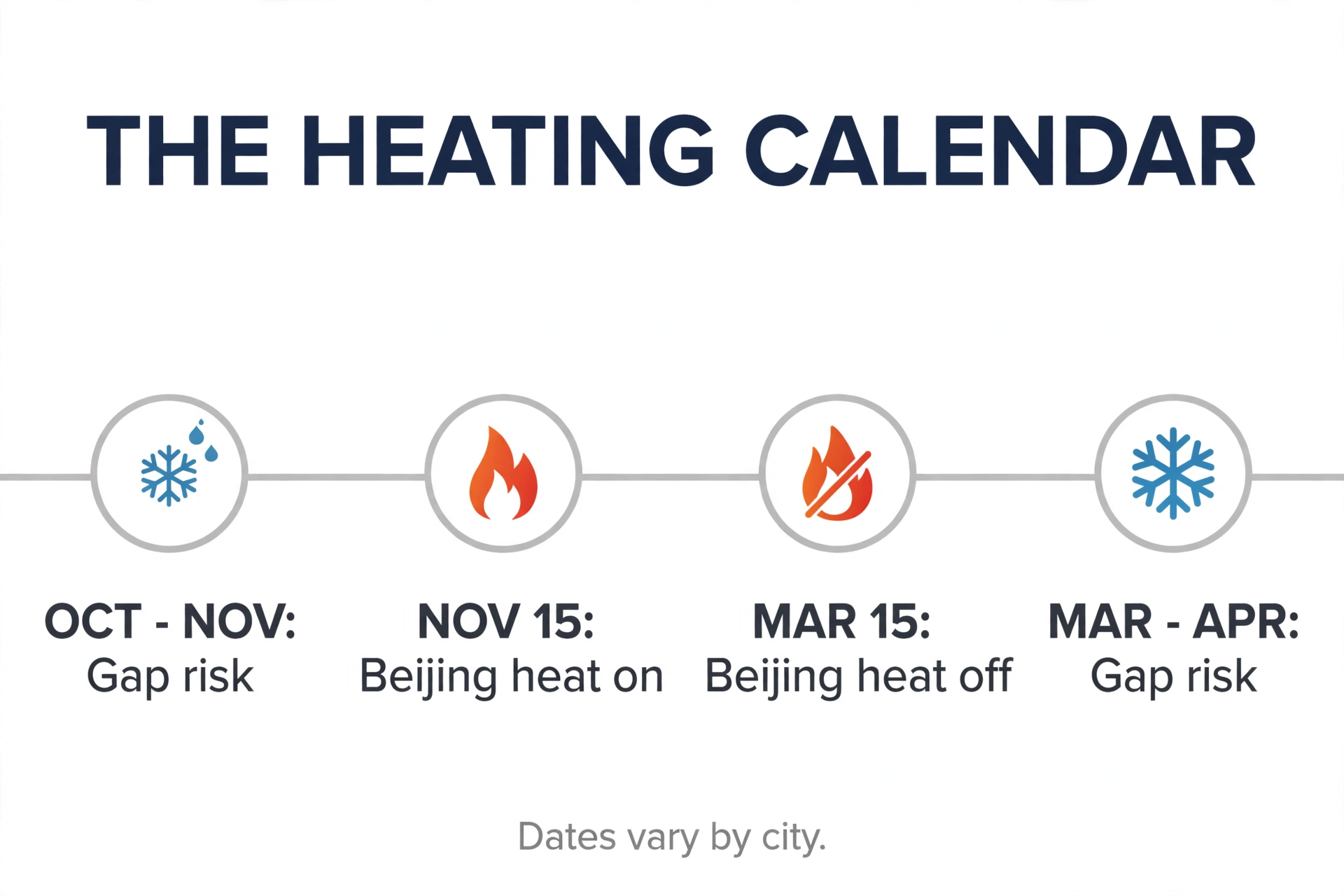
In much of northern China, heating is not something each building decides for itself on a cold morning. It is a city-wide system, switched on and off on a schedule. In Beijing, the heating season runs from November 15 to March 15 of the following year, according to the Beijing municipal heating rules. The government can adjust those dates for weather — for example, if cold weather persists — and in past cold snaps Beijing has started earlier, but the default calendar is what hotels, landlords, and travelers plan around. That is a long, warm winter once it starts. The problem is the weeks before it starts.
In October and early November, northern nights can already turn cold while the central system is still off. Many large hotels run one central climate system for the whole building. Cooling in summer and heating in winter often share pipes, pumps, and controls, and switching the building from one mode to the other is not a flick of your room thermostat. It can be a building-wide job that takes days, and in some reported cases managers have explained that restarting chillers after shutdown takes a week or more. So a hotel may stop cooling as autumn arrives, before central heating is available, and for a stretch of days or weeks the room has neither. That is the gap: too cold for air conditioning, too early for heating, and no dial on your wall that can fix it.
The same logic returns in spring. Around the March switch-off, a warm spell can leave rooms stuffy with no cooling yet, or a late cold snap can leave rooms chilly with heating already off. The autumn gap gets more attention because travelers arrive expecting crisp, pleasant weather and do not expect a cold bedroom. The spring gap matters too, especially in March and April, and the same questions below protect you in both seasons.
None of this means every hotel will be cold in October. The risk is real, varies by city, building, and week, and is concentrated in a specific window. That is why this article uses possibly and varies by city so often. The truth depends on the building you actually booked.
Why northern China heats on a calendar
To understand the gap, you need a one-minute history lesson, because the system was not designed for tourists. It was designed for residents, at scale.
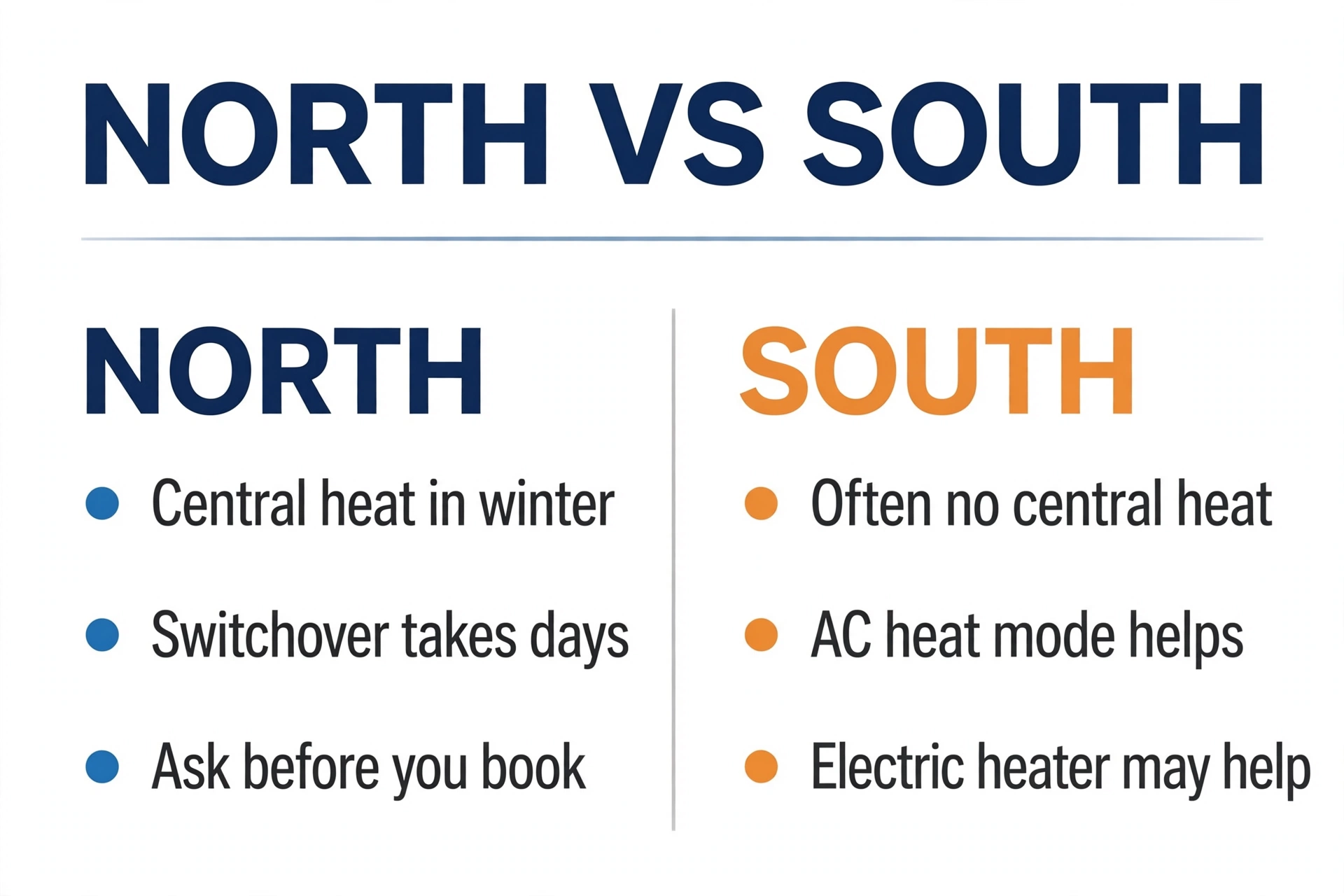
Northern China, roughly north of the Huai River and Qinling Mountains line, has a district heating tradition going back to the planned-economy era. Cities built huge networks that deliver hot water through pipes to whole neighborhoods at once. The network turns on for the season and stays on, regardless of a warm afternoon, and turns off at the end of the season, regardless of a cold night. That is efficient for millions of homes. It is inflexible for a traveler who arrives on October 28 and wants heat on October 28.
Beijing's November 15 to March 15 season is the reference point most travelers learn first, but it is not every city's calendar. Reported examples show the variation: Tianjin has in recent years started on November 1 under flexible rules, Shenyang has begun trial heating in late October, and Lanzhou has warmed its network in late October in cold years. Those examples do not mean your city will do the same this year. Each city has its own schedule.
South of the heating line, the picture flips. Cities such as Shanghai, Hangzhou, Suzhou, Nanjing, and Chengdu generally do not have city-wide central heating. Warmth then depends on the building: a split air conditioner in heat mode, an electric heater, underfloor heating, or sometimes nothing at all. Southern damp cold seeps into clothes and bedding, and a southern room in January can feel colder than a northern room, even when it is milder outside.
Who gets caught, and when
The classic gap traveler looks like this. They book Beijing, Xi'an, or another northern city for late October or early November, drawn by golden ginkgo, red leaves, thinner crowds after Golden Week, and shoulder-season prices. They pack for daytime walking: a light jacket, a sweater, good shoes. They assume the hotel will handle the night. On the first night, the room sits at a temperature that is fine for sitting in a coat and miserable for sleeping in a T-shirt. They add the hotel blanket, then their jacket, then they lie awake listening to the city and wondering why the thermostat does nothing.
A second group gets caught in spring, when a late cold snap arrives after heating has switched off. A third group gets caught in the south in winter, assuming "south means warm," then finding single-glazed windows, tile floors, and an air conditioner that struggles in heat mode. The lesson is the same: indoor warmth is not automatic. It is a feature of the building, the season, and the week, and you have to check it.
Children, older travelers, and anyone who sleeps cold should take this more seriously than a solo traveler who can tough out one night. A cold room is not just uncomfortable. It ruins sleep, and ruined sleep ruins the next day's Great Wall climb, high-speed train, or mountain hike. A five-minute question before booking is cheaper than a lost day of sightseeing.
How to ask the hotel — the question that saves the trip
Here is the habit that matters most. Before you book, and again a few days before arrival, ask the hotel directly about heating for your exact dates. Do not rely on the booking site's amenity list. "Air conditioning" on a listing does not mean heating. "Heating" on a listing does not mean heating will be on during your stay. You need a date-specific answer.
Use a short message you can paste into a booking app, email, or chat. Keep it simple, because the person answering may use translation software. For example:
"Hello, I will stay from [dates] in [city]. Will room heating be on during my stay? If not, can the room use air-conditioning heat mode? Can you provide an extra blanket or electric heater if the room is cold? Thank you."
If you are already in China and speaking to reception, a short spoken version helps. In pinyin, without needing to read characters, you can try: "Qingwen, gongnuan kaishi le ma?" — meaning, has the heating started? — and "You diannuanqi ma?" — do you have an electric heater? Staff will understand the question even if the pronunciation is imperfect, and they will usually tell you honestly whether the building is between seasons. Write down the answer, and the name of the person who gave it, so a night-shift colleague cannot contradict it later without a conversation.
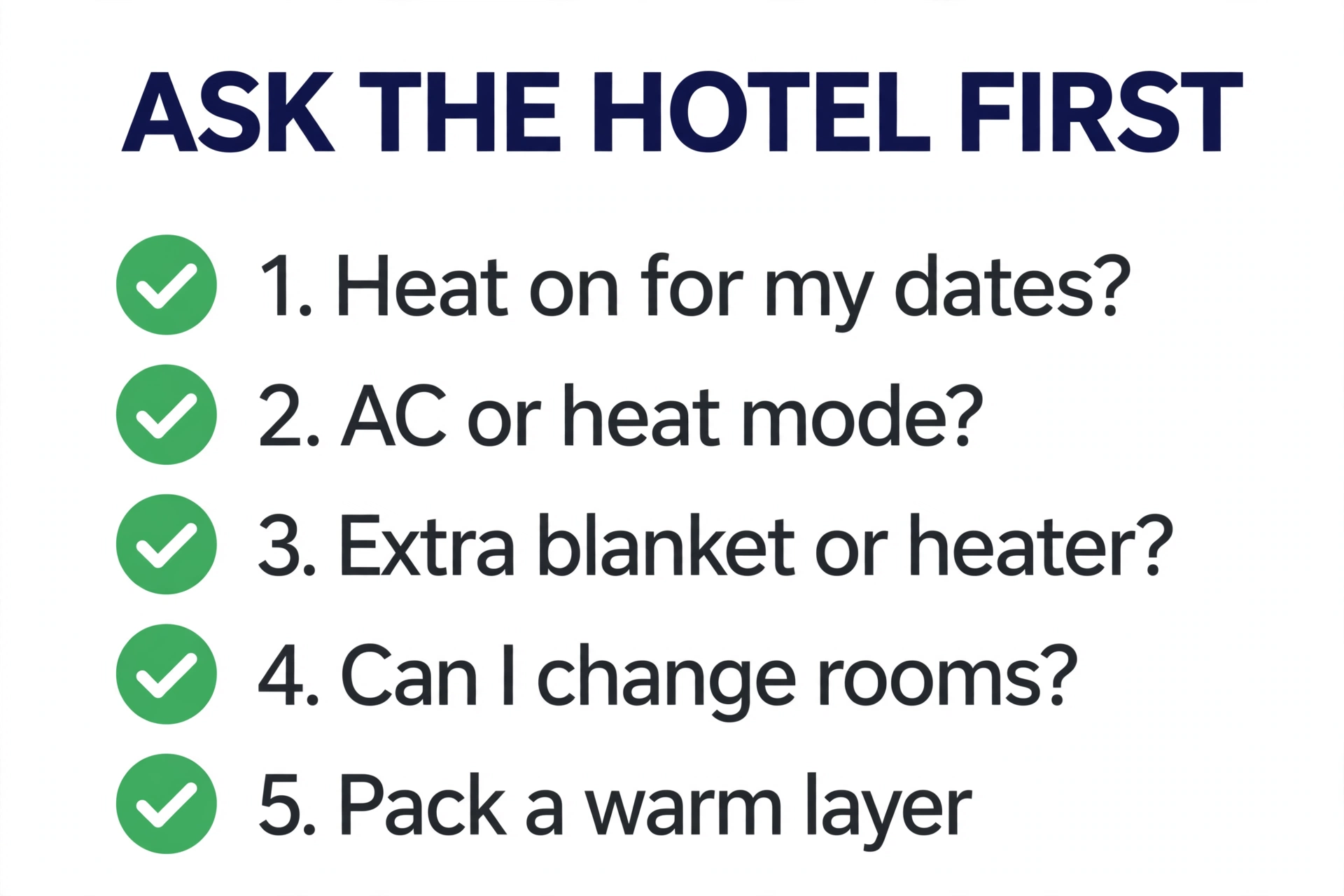
Ask five things, and you will know almost everything you need to know. First, will heating be on for my dates? Second, if not, does the room have air-conditioning heat mode, or an independent heater? Third, can you provide an extra blanket or electric heater on request, and is there a charge? Fourth, if my room is cold, can I change rooms — for example, to a room with a working heat source, a sunnier side, or a lower floor that may hold warmth better? Fifth, is there anything about this building I should know, such as windows that cannot be opened in a high-rise, or a central system that the hotel cannot override for one room? That last question matters, because in a tall building with sealed windows, you cannot solve a hot room by opening a window, and you cannot solve a cold room by asking reception to "turn on my heat" if the whole building is off.
If the answer is vague — "possibly," "we will try," "it depends on weather" — treat that as a warning, not a reassurance. Ask for a clearer answer in writing, or choose a different hotel. A hotel that can say "yes, heating is on from November 1 for your dates, and rooms have independent controls" has given you something useful. A hotel that cannot answer the question has told you something useful too.
Choosing a room that is less likely to be cold
Beyond the direct question, a few room choices reduce your risk. They do not guarantee warmth, but they tilt the odds.
Prefer newer hotels and serviced apartments with independent controls in the gap window, if your budget allows. A building with its own boiler, heat pump, or split units can respond to a cold night in a way a district-heated tower cannot. Ask older, larger, centrally heated properties more carefully in October, November, March, and April. Prefer a room that is not on a corner facing a cold wind, and test the heat on arrival — not at bedtime. Problems reported at 9 p.m. are solvable. Problems reported at 1 a.m. are not.
For multi-city trips, consider sequencing with the gap in mind: spend the coldest northern nights after the local heating start, or put a warmer southern stop in the middle of a northern swing. In the south in winter, ask whether the room and bathroom have heat mode, an electric heater, or underfloor heating. A warm bedroom with a freezing bathroom is a common southern surprise. Pack a warm layer for indoors, not just outdoors.
What to pack for the gap
Packing for the gap is not about bringing a winter expedition kit. It is about bringing one warm layer that works indoors. Think merino or fleece base layer, warm sleep socks, and a light packable down or fleece jacket you can wear in the room without feeling ridiculous. A silk or fleece sleep liner, if you already own one, weighs almost nothing and turns a cool bed into a comfortable one. A small, cheap thermometer is unnecessary; your body will tell you. What you need is not measurement. You need a layer you can add at night without unpacking your whole suitcase.
For children, pack one extra warm layer per child and a familiar blanket or sleep sack if they use one at home. For older travelers, pack warm socks and a cardigan specifically for the hotel, not just for the street. For anyone who runs cold, pack as if the room might be five degrees cooler than you expect. If the room turns out warm, you simply do not use the layer. If the room turns out cold, that layer is the difference between a story you laugh about later and a night you regret.
Do not pack an electric heater from home unless you have checked voltage, plug type, and hotel rules. China uses 220 volts, and many hotels prohibit personal heaters for fire safety. Ask the hotel for one instead. It is safer, it is usually free or cheap, and it puts the responsibility for a safe heater on the property, not on your luggage.
If you are already in a cold room tonight
If you are reading this from a cold room, call reception early and ask for a specific fix: extra blanket, electric heater, or room change. Those are room-level fixes that do not require changing the whole building. Close curtains at dusk, wear your warm layer to bed, and consider moving hotels for the next night if the problem cannot be fixed and will ruin the following day. Keep a written note of what reception told you.
A final word: cold rooms are a planning problem, not a China problem
Do not turn one cold night into a story about China being uncomfortable. Northern China heats millions of homes through one of the largest district systems in the world, and once it is on, rooms are often warmer than travelers expect. The gap is a transition problem, created by a calendar, a building system, and a travel season that do not quite line up. Travelers who understand it love October and November — golden leaves, clear skies, fewer crowds, better prices — and simply ask one question before they book, pack one warm layer, and test the room on arrival.
More hotel and packing guidance for first-time visitors is on hellochina.fans. So before your next northern China trip in autumn or spring, send that message. Will heating be on for my dates? The answer will tell you whether to book, to pack differently, or to choose another hotel. And on the night you arrive, when the room is warm and the city is golden outside, you will be glad you asked.
FAQ
Will my Beijing hotel have heating in late October? Possibly, but do not assume it. Beijing's central heating season is November 15 to March 15, with possible adjustment for weather, so late October is before the default start. Some buildings have independent heating, and some cities start earlier, but you must ask your exact hotel for your exact dates.
What about early November? Early November is still in the gap window for Beijing under the default calendar, unless the start is brought forward for cold weather. Ask the hotel, and do not rely on a booking-site amenity list.
Does the gap affect southern China too? Differently. The south generally has no city-wide central heating, so the question is whether your specific room has heat mode, an electric heater, or underfloor heating. A southern room in winter can feel cold and damp even when the outdoor temperature is milder than in the north.
Can I just turn on the air conditioning for heat? Possibly, if your room has a split unit with heat mode, or an independent system. In many large, centrally heated buildings, you cannot switch one room from cooling to heating while the building is between seasons. Ask whether your room has heat mode, not just whether the hotel "has air conditioning."
What should I ask the hotel before booking? Will heating be on for my dates? If not, is there heat mode or an independent heater? Can you provide an extra blanket or electric heater? Can I change rooms if mine is cold? Get the answer in writing when you can.
What should I pack? One warm indoor layer, warm sleep socks, and, for children, one extra warm layer each. Do not bring a personal electric heater from home without checking voltage, plug type, and hotel rules; ask the hotel for one instead.
What if my room is already cold tonight? Call reception early and ask for a specific fix: extra blanket, electric heater, or room change. Close curtains at dusk, wear your warm layer to bed, and consider moving hotels for the next night if the problem cannot be fixed and will ruin the following day.
Does the same gap happen in spring? Yes, possibly. Around the March switch-off, and into April, rooms can be stuffy with no cooling yet, or chilly after a late cold snap with heating already off. The same questions protect you in March and April as in October and November.
Are newer hotels always warmer in the gap? Not always, but they are more likely to have independent controls that can respond to a cold night. Older, larger, centrally heated properties need more careful questioning in the gap window. Always confirm for your exact hotel and dates, rather than assuming by brand or age alone.
Sources checked before writing: Beijing municipal heating rules (heating season November 15 to March 15, government may adjust for weather); Beijing heating guidance (earlier start possible if cold persists); reported city variation (Tianjin flexible start, Shenyang trial heating, Lanzhou network warming in late October in cold years); hotel central-system switchover explanations in guest replies. No specific hotel is named or guaranteed. Dates vary by city.