
Foreign Wallets in China: Alipay+, GCash and Other Overseas Apps Compared
Foreign Wallets in China: Alipay+, GCash and Other Overseas Apps Compared Key Takeaways Mainland China runs on QR code payments, and two rails dominate: Alipay Ant Group and WeChat
Foreign Wallets in China: Alipay+, GCash and Other Overseas Apps Compared
Key Takeaways
- Mainland China runs on QR-code payments, and two rails dominate: Alipay (Ant Group) and WeChat Pay (Tencent). Almost everything else is built on top of them.
- If your home wallet is an Alipay+ overseas wallet — GCash in the Philippines, Touch 'n Go eWallet in Malaysia, TrueMoney in Thailand, Kakao Pay in South Korea, AlipayHK in Hong Kong — you can often scan Chinese merchant QR codes without opening a Chinese bank account or installing a second app.
- If your wallet is not an Alipay+ partner, the most reliable short-trip setup is still linking a Visa or Mastercard to the Alipay or WeChat Pay app.
- Expect small-transaction fee waivers, a percentage fee above a threshold (commonly around 3%), per-transaction and annual caps, and a minority of merchants where foreign-card-funded payments fail.
- Always carry a little cash and one physical card as a fallback, and update your payment app before you fly.
1. Introduction
A first-time visitor to China usually discovers the payment problem at the worst moment: standing at a convenience store counter, a taxi window or a museum ticket desk, holding a Visa card that the merchant cannot swipe. China's retail economy moved to QR codes years ago, and cash — while still legal tender and still accepted — is increasingly the slow option rather than the normal one.
The confusion is compounded by terminology. Travelers hear three different things at once: "use Alipay," "use WeChat Pay," and "your own wallet might work now." Those are not the same instruction, and they lead to different setups, different fees and different failure modes.
This guide untangles that. It explains what Alipay+ actually is (a network, not an app), which overseas wallets can currently pay in mainland China, how those routes compare with simply linking a foreign card to Alipay or WeChat Pay, and where each option breaks down. It is written for short-term travelers, students and new expats who want a working payment method on arrival — part of HelloChina's practical coverage of entry, transport and everyday logistics for visitors to China.
2. How payments actually work in China: three routes, one network
Core conclusion: Almost every payment you will make in China resolves to one of three routes — a Chinese wallet funded by a foreign card, an overseas wallet connected through Alipay+, or cash/physical card. Choose your route before you arrive, not at the till.
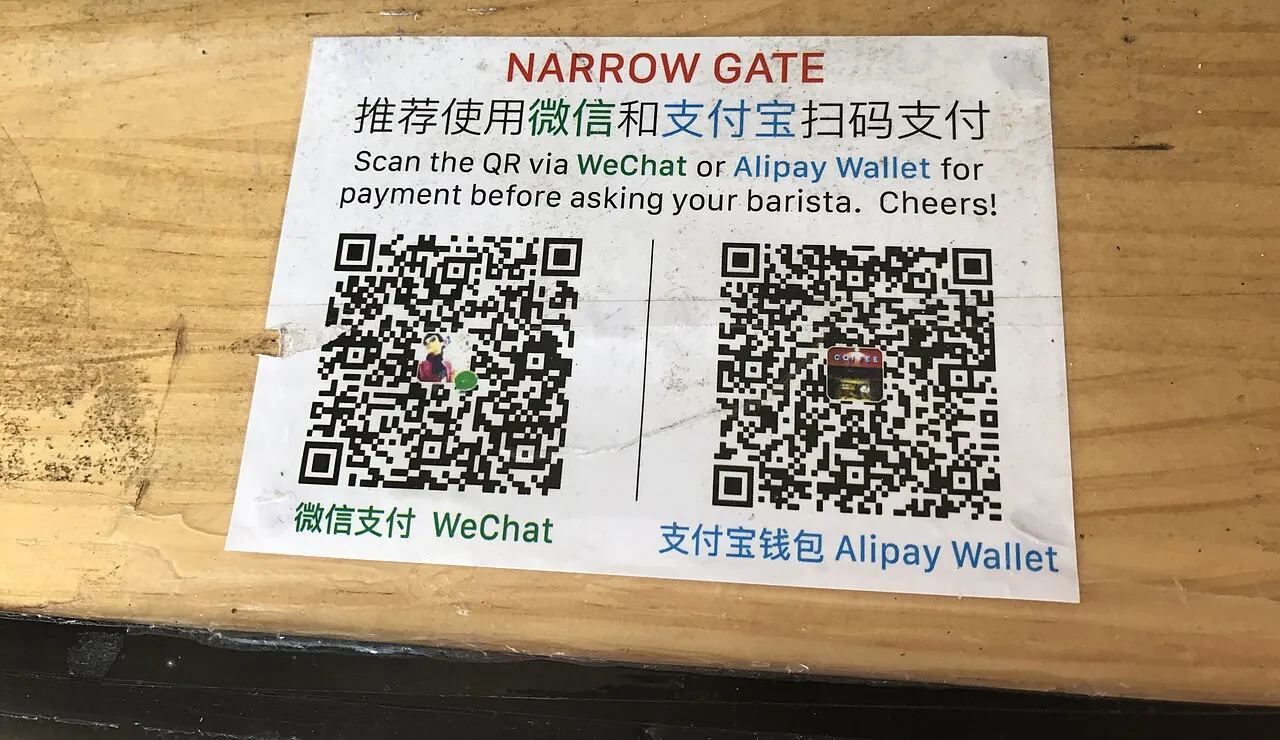
The reasoning. Chinese merchants display two kinds of QR code. The first is a merchant code printed on a stand or sticker; the customer scans it and types the amount. The second is a personal payment code on the customer's phone, which the merchant scans with a handheld device or a phone. Both are settled through Alipay or WeChat Pay.
That structure is why cross-border schemes work at all. Alipay+ is Ant Group's cross-border payment and digitalization network: it connects overseas wallet providers to the Alipay merchant network. When a GCash user scans an Alipay merchant QR code in Shanghai, the transaction is routed through Alipay+ back to GCash, and the user's wallet is debited in their home currency at the wallet provider's exchange rate. WeChat Pay has a similar but more limited set of inbound arrangements, and it also supports directly linked international cards.
Three practical consequences follow:
- You do not need a Chinese bank account for a normal tourist trip, though a Chinese account remains the cheapest and most complete option for residents.
- Your home wallet only works if it is a signed Alipay+ partner and the China corridor is enabled — not every partner wallet supports every market at launch.
- Settlement currency matters. With an Alipay+ wallet you are usually charged in your home currency after conversion by your wallet provider. With a foreign card linked to Alipay or WeChat Pay, you are charged in CNY and your card issuer converts, often adding a 1–3% foreign transaction fee.
Scenario advice: If you already use a major Asian e-wallet, check inside the app for a "pay overseas" or "mainland China" section a week before departure. If it is listed, you may not need to install anything else. If it is not, plan on the Alipay app with your card attached.
3. Alipay+ overseas wallets: paying with the app you already have
Core conclusion: Alipay+ partner wallets are the lowest-friction option for travelers from supported markets, but they are convenience tools, not full replacements for Alipay — person-to-person transfers and some in-app purchases typically remain out of reach.
What Alipay+ is. It is a brand and technical layer that lets partner wallets interoperate with Alipay's merchant network. You do not download "Alipay+." You update your existing wallet, complete its identity verification, and look for the Alipay+ or "pay in China" feature.
Wallets that have been enabled for mainland China payments include, among others:
| Market | Wallet | Notes |
|---|---|---|
| Philippines | GCash | Scan Alipay merchant QR codes; verified accounts get higher limits |
| Malaysia | Touch 'n Go eWallet | Widely used option for Malaysian travelers |
| Thailand | TrueMoney | Popular for Thai visitors |
| South Korea | Kakao Pay | Korean users pay via Alipay+ QR corridors |
| Hong Kong | AlipayHK | Separate app from mainland Alipay; strong China coverage |
| Macau | MPay | Cross-border QR support |
| Singapore | Changi Pay, OCBC Digital | Bank and airport-linked wallets in the programme |
| Mongolia | HiPay | Regional partner wallet |
The list expands and occasionally changes, so verify inside your own app rather than relying on any published roster, including this one.
How to set it up:
- Update the wallet to the latest version and complete full identity verification (usually a government ID plus a selfie).
- Find the overseas or China payment section — often labelled "Pay abroad," "Alipay+," or with a QR icon.
- Confirm the exchange rate display and any cross-border fee your wallet charges. These are set by your wallet provider, not by the Chinese merchant.
- At the counter, scan the merchant's Alipay QR code and enter the amount if prompted, or show your payment code if the merchant scans.
Where it breaks down: Payments to individuals (splitting a bill, paying a landlord, sending money to a friend) are generally not supported through Alipay+ corridors. Small vendors whose code is a personal rather than a merchant code may fail. Refunds go back to your wallet and can take days. And if your wallet imposes a low KYC tier limit, a hotel bill can exceed it.
4. Alipay and WeChat Pay with a linked foreign card
Core conclusion: For anyone without a supported Alipay+ wallet, linking an international card to Alipay is the most dependable route; WeChat Pay works too but is better treated as a secondary wallet.
Setup. Both apps accept major international card networks, and both have added English interfaces and passport-based verification aimed at visitors. You can add a card before you travel. Expect to verify your identity with a passport photo and to receive SMS codes on your home number, so make sure that number works on roaming or via a travel eSIM that supports SMS.
Costs and limits. As of the most recent published policies, both platforms waive their service fee on smaller transactions — currently around 200 CNY per transaction — and apply a percentage fee of roughly 3% above that threshold. Both also apply per-transaction ceilings and annual cumulative limits on foreign-card spending, and your card issuer may add its own foreign transaction fee. Policies and thresholds change, so read the in-app fee notice before you rely on a specific number.
What typically does not work with a foreign-card-funded wallet:
- Transfers to another person's Alipay or WeChat account
- Red packets (hongbao) and some social payment features
- Certain mini-program and in-app purchases inside WeChat
- Merchants that have disabled foreign-card acceptance, including some small vendors and a few online services
Scenario advice: Use Alipay as your primary and WeChat Pay as backup, since a small number of merchants accept only one of the two. Keep both apps logged in and funded, and screenshot your payment code in case of network trouble — though the code itself refreshes, so a live connection is still needed to pay.
5. Key comparison: which route fits which traveler
| Route | Best for | Setup effort | Fees and limits | Main watch-outs |
|---|---|---|---|---|
| Alipay app + international card | Most short-term visitors from unsupported markets | Medium — passport verification, SMS | Fee-free under ~200 CNY, ~3% above; per-transaction and annual caps | No person-to-person transfers; some merchants decline foreign-card funding |
| WeChat Pay + international card | Travelers already using WeChat | Medium–high — account verification can be fiddly | Similar threshold and percentage structure | Weaker foreign-card coverage than Alipay; some features blocked |
| Alipay+ overseas wallet (GCash, Touch 'n Go, TrueMoney, Kakao Pay, AlipayHK) | Travelers from partner markets who want one app | Low — if the wallet is already verified | Wallet-set exchange rate plus any cross-border fee | Not all merchants; wallet KYC limits; refunds are slow |
| Cash (CNY) | Backup, rural areas, tips, small vendors | None | No fees; exchange rate at bank or ATM | Small vendors may lack change; ATMs can be scarce outside cities |
| Physical UnionPay / Visa / Mastercard | Hotels, airports, large chains, high-value purchases | None | Card issuer FX fees | Declined at most small merchants and many restaurants |
Decision rule: supported Alipay+ wallet → use it. Not supported → Alipay with a foreign card, WeChat Pay as backup. Either way → carry 200–500 CNY in cash and one physical card.
6. What can go wrong, and how to handle it
Core conclusion: Most payment failures in China are configuration problems, not fraud blocks — and they are usually solvable in under ten minutes if you know which layer to check.
- Payment declined at a merchant: ask whether they accept the app you are using, then try the other major app. If both fail, the merchant may have disabled foreign-card acceptance; pay cash.
- "Real-name verification required": your wallet needs passport verification completed before cross-border payment activates. Do this at home, not at a till.
- SMS code never arrives: international SMS delivery is unreliable on some roaming setups. Fix this before departure — it is the single most common blocker.
- Amount exceeds your limit: split the payment, use a physical card at a hotel desk, or upgrade your wallet's verification tier.
- Refund not showing: cross-border refunds settle through the wallet provider and commonly take several business days longer than domestic refunds.
7. FAQ
Q1. Can I use GCash to pay in China without a Chinese bank account?
Yes, if your GCash account is fully verified and the China corridor is enabled in your app. You scan the merchant's Alipay QR code and the amount is debited from your GCash balance or linked funding source, converted from CNY. You do not need the Alipay app or a Chinese bank account, but you also cannot use GCash for person-to-person transfers in China.
Q2. Is Alipay+ an app I need to download?
No. Alipay+ is a cross-border network operated by Ant Group that connects partner wallets to Alipay's merchant network. You either use a partner wallet you already have, or you use the Alipay app itself with an international card linked.
Q3. What fees should I expect when paying with a foreign card in China?
Both Alipay and WeChat Pay have waived service fees on small transactions (around 200 CNY) and applied a fee of roughly 3% above that threshold, alongside per-transaction and annual caps. Your card issuer may add a foreign transaction fee of about 1–3%. Confirm current terms in the app before you travel, since the policies are revised periodically.
Q4. Do I still need cash in China?
For most city travel, no — but carry some anyway. Cash remains legal tender and must be accepted, yet small vendors may struggle to give change, and a dead phone battery or a failed verification can otherwise leave you stuck.
8. Conclusion
The practical answer depends less on which app is "better" than on which market you are coming from. Travelers from the Philippines, Malaysia, Thailand, South Korea, Hong Kong, Macau and Singapore should check first whether their existing wallet has an active Alipay+ China corridor — that is the simplest path, and it requires no new accounts. Everyone else should set up the Alipay app with an international card before flying, add WeChat Pay as a second wallet, and treat cash as the safety net rather than the plan.
Two habits make the difference: complete identity verification at home, while your usual phone number and documents are to hand, and keep a small cash reserve for the handful of counters where digital payments still fail. Set up that way, payments in China stop being a daily problem and become background infrastructure — which is exactly what they are for locals.