
WeChat Pay Not Working in China: Fix It by Symptom (Cards, QR, Verification)
WeChat Pay Not Working in China: Fix It by Symptom Cards, QR, Verification Key Takeaways Most WeChat Pay failures for foreign visitors fall into three buckets: card setup adding or
WeChat Pay Not Working in China: Fix It by Symptom (Cards, QR, Verification)
Key Takeaways
- Most WeChat Pay failures for foreign visitors fall into three buckets: card setup (adding or authorizing an international card), identity verification (passport and phone-number checks), and QR payment rules (merchant codes work, personal codes usually don't).
- WeChat Pay accepts major international card networks at commercial merchants, but it does not support peer-to-peer transfers, red packets, or many personal QR codes when the funding source is a foreign card.
- Payments under roughly 200 CNY have generally been fee-free; larger international-card transactions carry a service fee, and per-transaction and annual ceilings apply. Confirm the current numbers on the confirmation screen before paying.
- Repeated retries make things worse. Failed attempts can trigger risk controls that temporarily lock the payment function, so change one variable at a time and wait before trying again.
- Always carry a cash backup and a second payment app. WeChat Pay plus Alipay plus a few hundred yuan in notes covers almost every realistic failure scenario.
1. Introduction
You land in Shanghai or Chengdu, open WeChat, and the payment screen refuses to cooperate. The card won't add. The passport photo keeps getting rejected. The QR code at a noodle shop scans fine but the transaction fails. Meanwhile the queue behind you is growing.
This is one of the most common practical frustrations for international travelers in China, because mobile payment is not optional in the way it is in many other countries. Large cities still accept cash and bank cards in hotels and malls, but small restaurants, street stalls, taxis, attraction ticket machines, and many mini-programs inside WeChat assume a mobile wallet. When WeChat Pay is not working in China, the problem is rarely "the app is broken." It is almost always one specific link in a chain: the card, the identity check, the merchant's code type, or the account's risk state.
This guide is organized by symptom rather than by feature, so you can start from what you actually see on screen and work backward to the cause. Each section gives the likely explanation, the fix sequence, and the boundary conditions where the fix will not help and you should switch to a fallback.
2. Quick Triage: Match Your Symptom to the Right Fix
Core conclusion: identify which of the four failure stages you are stuck at before changing anything in the app. Most wasted effort comes from troubleshooting the wrong stage.
WeChat Pay for foreign users involves four gates, and each has a different failure signature:
| Stage | What you see | Most likely cause | First move |
|---|---|---|---|
| 1. Add card | "Card not supported," "Verification failed," or the card simply won't save | Card not enabled for cross-border use, or billing details don't match the issuing bank's records | Check with your bank that international e-commerce is enabled; re-enter name and billing address exactly as on the card statement |
| 2. Identity verification | Passport photo rejected repeatedly; "real-name verification required" | Glare, cropped corners, expired passport, or name-order mismatch | Retake in flat daylight on a dark background; match passport name order exactly |
| 3. Scan or present a code | Code scans but payment fails; "payment method not supported" | Merchant uses a personal QR code, or a terminal that can't process foreign cards | Ask whether they accept WeChat Pay from a foreign card; try showing your payment barcode instead of scanning theirs |
| 4. Risk control | Sudden failure after several attempts; function temporarily disabled | Too many failed attempts, new account, unusual location or amount | Stop retrying for a few hours; use a fallback in the meantime |
Practical advice: before your trip, complete stages 1 and 2 at home, on a stable connection, with your passport and card in hand. Verification friction is much easier to solve before you are standing at a counter. If you are already in China with a broken setup, work through stages in order — a card problem will not be fixed by re-verifying your identity, and vice versa.
3. Card Problems: When the Card Won't Add, Won't Authorize, or Hits a Limit
Core conclusion: card failures are usually bank-side permissions or a mismatch between the name you type and the name on file, not a WeChat bug.
When you add an international card to WeChat Pay, the app passes the details to your issuing bank for authorization. That step involves the card number, expiry, security code, cardholder name, and sometimes billing address. Any mismatch can produce a generic failure message that gives you no clue which field was wrong.
Work through these checks in order:
- Cross-border e-commerce permission. Many banks block or restrict international online transactions by default, especially debit cards. Call or use your banking app to enable international and online transactions for the travel period, and tell them you will be using the card in China so their fraud system doesn't decline a legitimate charge.
- Name format. Enter your name in the same order as printed on your passport and card. Middle names cause trouble: try including and excluding them, one attempt at a time. Do not use nicknames, initials, or a Chinese name unless it is legally on the document.
- Card type. Credit cards tend to authorize more smoothly than debit cards. Prepaid travel cards often fail outright because they cannot complete the identity checks the payment network requires.
- 3-D Secure / one-time code. If your bank sends a verification code by SMS or push notification, complete it within the time window. If your home number won't receive texts abroad, switch to your bank's app-based confirmation before you travel.
- Limits and fees. International-card spending inside WeChat Pay is subject to caps. As commonly reported, single transactions are capped in the low thousands of yuan and annual totals around 50,000 CNY, with a service fee applied above roughly 200 CNY per transaction. These parameters have changed several times, so check the notice shown on the payment confirmation screen rather than relying on any older guide, including this one.
- Declines at the merchant. A card that works in one shop and fails in another is often a merchant-side issue: a terminal that cannot handle foreign-issued cards, or a merchant that has disabled that payment route.
Scenario: you add a Visa credit card successfully and pay at a convenience store, but a 1,200 CNY purchase at a restaurant fails. The most likely explanation is not the card — it is the fee plus limit screen you dismissed, or a bank fraud check on a larger-than-usual amount. Split the payment, approve the bank's confirmation prompt, or use a different method for that transaction.
4. Verification Problems: Passport, Name, and Phone Number
Core conclusion: identity verification failures are almost always image-quality or name-matching issues, and each failed submission makes the next one harder.
WeChat Pay requires real-name verification to unlock full functionality, and for foreign users that means a passport rather than a Chinese ID. The process is straightforward when the inputs are clean and frustrating when they are not, because the app rarely tells you precisely what went wrong.
Common causes and fixes:
- Photo quality. Shoot in flat, indirect daylight against a plain dark surface, with all four corners visible and no glare across the photo page. Screenshots, photocopies, and photos of a phone screen are frequently rejected. Avoid flash.
- Expired or near-expiry documents. Use the passport you traveled on and make sure it is valid well beyond your trip.
- Name mismatch across systems. The name on the passport, the name registered to your WeChat account, and the name on your bank card should line up. A missing middle name or an inverted surname is enough to fail the check.
- Phone number. WeChat works with many international numbers for registration, but some verification and recovery flows assume a Chinese mobile number. If you plan to stay a while, a local SIM registered in your own name removes a whole category of problems.
- Attempt limits. After several failed submissions the system may pause verification for a period. Wait rather than hammering it.
Boundary condition: if verification keeps failing while you are already in China and you need payments immediately, do not spend your whole first day on it. Switch to a fallback, complete the verification later on better Wi-Fi, and keep the passport photo set saved in your camera roll so you can retry quickly.
5. QR Problems: Why the Code Scans but the Payment Fails
Core conclusion: the QR code itself rarely fails. What fails is the payment route behind it.
China runs on two QR patterns. In the first, you scan the merchant's code and type the amount. In the second, the merchant scans the barcode or QR code generated inside your WeChat Pay screen. Both are normal; the second is often more reliable with foreign cards because the merchant's terminal handles the transaction directly.
The failures fall into recognizable patterns:
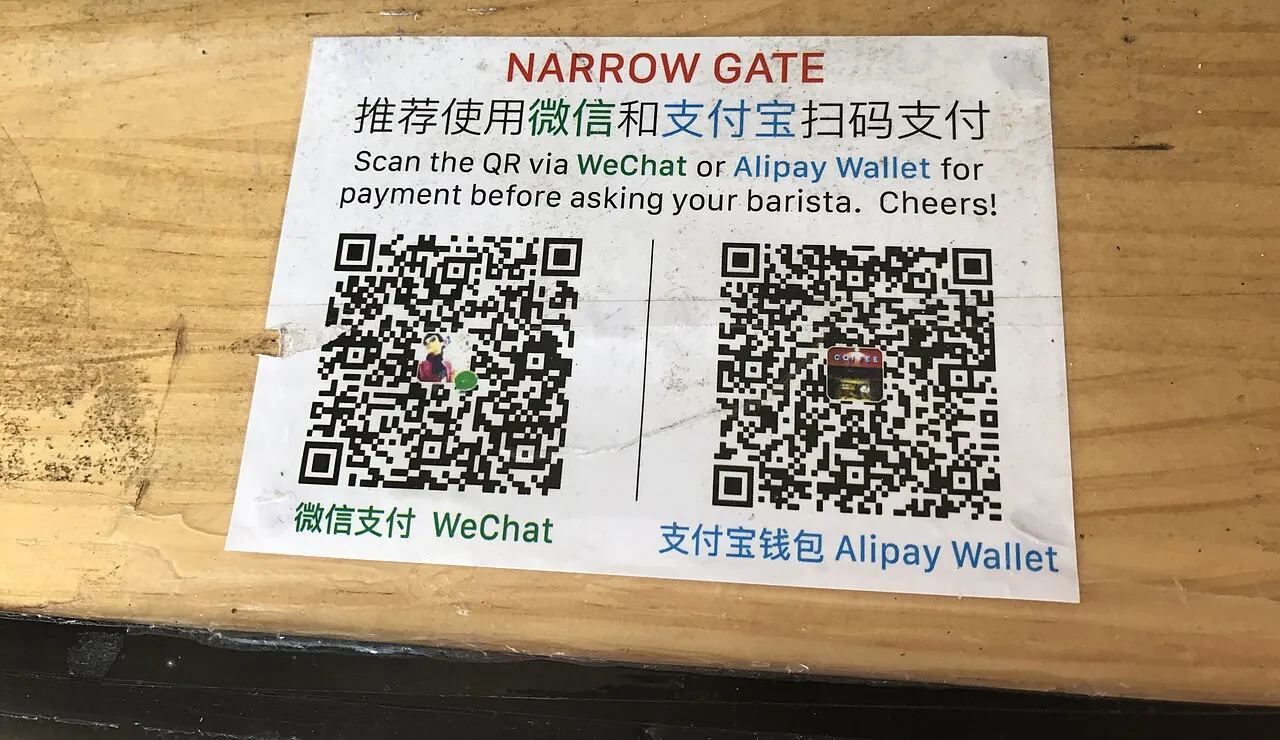
- "Payment method not supported." This commonly appears when the code belongs to an individual rather than a registered business. Personal QR codes are typically tied to balance or bank-card funding, and a foreign credit card cannot be used for peer-to-peer transfers, red packets, or many personal collections. This is a rule, not a glitch. Ask the vendor if they have a business code, or pay cash.
- Terminal limitations. Some smaller merchants use payment terminals or mini-apps configured only for domestic cards. Nothing you change on your phone will fix that.
- Network and screen issues. Public Wi-Fi in stations and cafés sometimes blocks or throttles payment traffic. Switch to mobile data. If the merchant is scanning your screen, raise brightness, remove privacy screen protectors, and refresh the barcode — the code rotates every minute for security.
- Mini-program payments. Attraction tickets, train tickets, and some services are sold through mini-programs inside WeChat. These sometimes reject foreign cards even when your wallet works elsewhere. In that case buy through the operator's official website, an international booking platform, or the ticket counter.
- Refunds. Refunds to an international card can take days to weeks to appear. If a payment succeeds but the merchant cancels the order, keep the transaction record and follow up in the app rather than paying again immediately.
Scenario: a market stall shows a printed QR code taped to a post. Your scan opens a transfer screen with no merchant name. That is a personal code, and your foreign card will not clear it. Cash is the answer, and it is worth keeping 100–200 CNY in small notes for exactly this situation.
6. Fallbacks and Trade-offs: What to Use When WeChat Pay Still Fails
Core conclusion: treat WeChat Pay as one tool in a small kit, not as a single point of failure. Redundancy is the real fix for payment anxiety in China.
| Method | Best for | Limitations to plan around |
|---|---|---|
| WeChat Pay with an international card | Restaurants, shops, convenience stores, transport in many cities, mini-programs | No peer-to-peer transfers; fee and caps above the small-payment threshold; occasional merchant-side rejections |
| Alipay with an international card | Similar coverage, often broader acceptance at tourist-facing merchants | Separate setup and verification; its own limits and fee structure |
| Cash in RMB | Street vendors, personal QR codes, rural areas, tips, small transport | Some vendors struggle to give change for large notes; keep small denominations |
| Physical bank card or UnionPay | Hotels, department stores, ATMs | Not accepted at most small vendors |
| Chinese bank account linked to WeChat | Long stays: full functionality including transfers and red packets | Requires in-person account opening and usually a local phone number |
| Prepaid top-up products for visitors | Short trips, when card linking fails | Availability and eligibility vary by city and time; check current terms |
Practical advice for a one- to two-week trip: set up WeChat Pay and one backup app before departure, carry a few hundred yuan in cash, and keep a physical credit card for hotels. That combination handles nearly every situation. If you are staying for months, invest the half-day in opening a local bank account — it removes limits and unlocks the full wallet, including the peer-to-peer payments you will eventually need for splitting bills and paying landlords.
One more consideration worth noting: payment rules for foreign cards in China have been updated repeatedly since cross-border mobile payment was opened up, generally in the direction of easier access. Any specific number — fee rate, per-transaction cap, which card networks are supported — should be treated as current-at-time-of-writing rather than permanent.
7. FAQ
Q1. Can I use WeChat Pay in China with a foreign credit card?
Yes, for payments to registered merchants. You add the card inside WeChat Pay, complete real-name verification with your passport, and then scan merchant codes or show your payment barcode. It does not work for peer-to-peer transfers, red packets, or many personal QR codes, and larger transactions carry a service fee plus per-transaction and annual caps.
Q2. Do I need a Chinese bank account to use WeChat Pay?
No, not for ordinary merchant payments. A foreign card plus passport verification is enough for shops, restaurants, and many transport and ticketing mini-programs. A Chinese bank account becomes worthwhile for longer stays, because it unlocks transfers, red packets, higher limits, and fewer merchant-side rejections.
Q3. Why does my payment fail only at small shops?
Small shops often display a personal QR code rather than a registered merchant code. Personal codes rely on wallet balance or a domestic bank card and generally cannot be funded by a foreign credit card. Ask for a business code, try having the merchant scan your payment barcode, or pay cash.
Q4. What should I do if my passport verification keeps getting rejected?
Retake the photo in even daylight with all four corners visible and no glare, and confirm the name matches your passport exactly, including order and middle names. After several failures the system may pause verification, so wait a few hours before retrying. If you need to pay in the meantime, use cash or a backup payment app rather than repeating failed attempts.
8. Conclusion
When WeChat Pay is not working in China, the fastest path forward is diagnostic rather than repetitive. Identify the stage you are stuck at — card setup, identity verification, QR payment rules, or risk control — and fix that stage specifically. Card problems are usually bank permissions and name matching. Verification problems are usually photo quality and document consistency. QR problems are usually about who owns the code, not about your phone. Risk-control blocks are usually caused by retrying too fast, and they resolve with patience rather than persistence.
Prepare the two setup stages at home before you fly, keep a cash reserve and a second payment app for the gaps, and treat published limits and fees as things to confirm on screen rather than memorize. Do that, and payment stops being the stressful part of the trip.
For more practical, English-first guidance on traveling and living in China — visas, itineraries, food, safety, and everyday logistics — see HelloChina at hellochina.fans.