
Will China's 30-Day Visa-Free Stay Beyond December 31, 2026? What History Actually Says
The current 30-day visa-free extension ends on 31 December 2026. History shows November renewals, not a promise — plan for either answer.
They had the flights open in another tab, the hotel shortlist on the table, and one question they could not answer: if we travel in February 2027, will we still walk in without a visa — or will we need one? This article does not pretend to know. It shows you what is actually known, what history actually shows, and how to plan so that either answer still leaves you with a trip.
Let us start with the couple at the kitchen table, because you may be them. They are not influencers and they are not travel hackers. They are two people from Manchester who have wanted to see China properly for years — Beijing first, then Xi'an, then a slow train south — and who finally have the leave approved and the savings set aside. In February 2026, China added the United Kingdom to its visa-free list. Suddenly the biggest friction in the whole trip disappeared. No form, no consulate visit, no fee. Thirty days, for tourism, business, family visits, exchanges, and transit. That is a proper holiday, not a rushed stopover.
Then they read the small print: 24:00 Beijing time on 31 December 2026. Their trip is in February 2027 — on the wrong side of the date. They searched, and found confident answers pointing in opposite directions: renewal was certain because it had always been renewed, or the scheme would end because no extension had been announced. Both sounded sure. Neither could know.
This article refuses both certainties. If you only have five minutes, read the timeline infographic and the plan at the end. If you are booking for 2027, read the whole thing.
For the full, regularly updated guide behind this article, see the HelloChina visas and entry guide: https://hellochina.fans/guides/visas-entry
What is actually ending — and what is not
First, precision, because most of the confusion comes from blurring three different things into one deadline.
The thing with a date on it is China's unilateral visa-free policy. "Unilateral" means China waives visas for other countries' citizens without requiring the same in return. Holders of ordinary passports from the listed countries may enter China without a visa for business, tourism, family visits, transit, or exchanges, for a stay of no more than 30 days. The current extension, announced by Chinese embassies, runs until 24:00 on 31 December 2026. The main list covered in most reporting is 48 countries, including most of Europe, Australia, New Zealand, Japan, South Korea, and — since 17 February 2026 — the United Kingdom and Canada.
That is the policy in question — not the whole of Chinese immigration. Two other doors stay open regardless, and confusing them with it causes needless panic or false relaxation.
The first is mutual exemption: bilateral deals with no set end date. Singapore, Thailand, and Malaysia are the usual examples — their 30-day arrangements do not live or die on 31 December 2026. Check your own passport's agreement, as terms differ by country.
The second is 240-hour visa-free transit. That is a standing policy, not tied to this deadline, but it is not a substitute for a 30-day holiday. It only works on a qualifying itinerary: you transit through China to a third country or region, with a confirmed onward ticket. Flying home does not count. If your plan is a two-week holiday that starts and ends at home, transit does not rescue it. If your plan is genuinely a transit — say, a longer Asian journey with China in the middle — it is a real option, with its own strict test. Do not stretch it to fit a trip it was not designed for.
The United States is not on the 30-day list at all — American travellers need a visa or a qualifying transit itinerary. So place yourself first: unilateral visa-free, mutual exemption, transit, or visa? Only the first has a 31 December 2026 date on it.
The timeline: three Novembers, three decisions
Here is the history, with dates, because dates are what separate a pattern from a vibe.
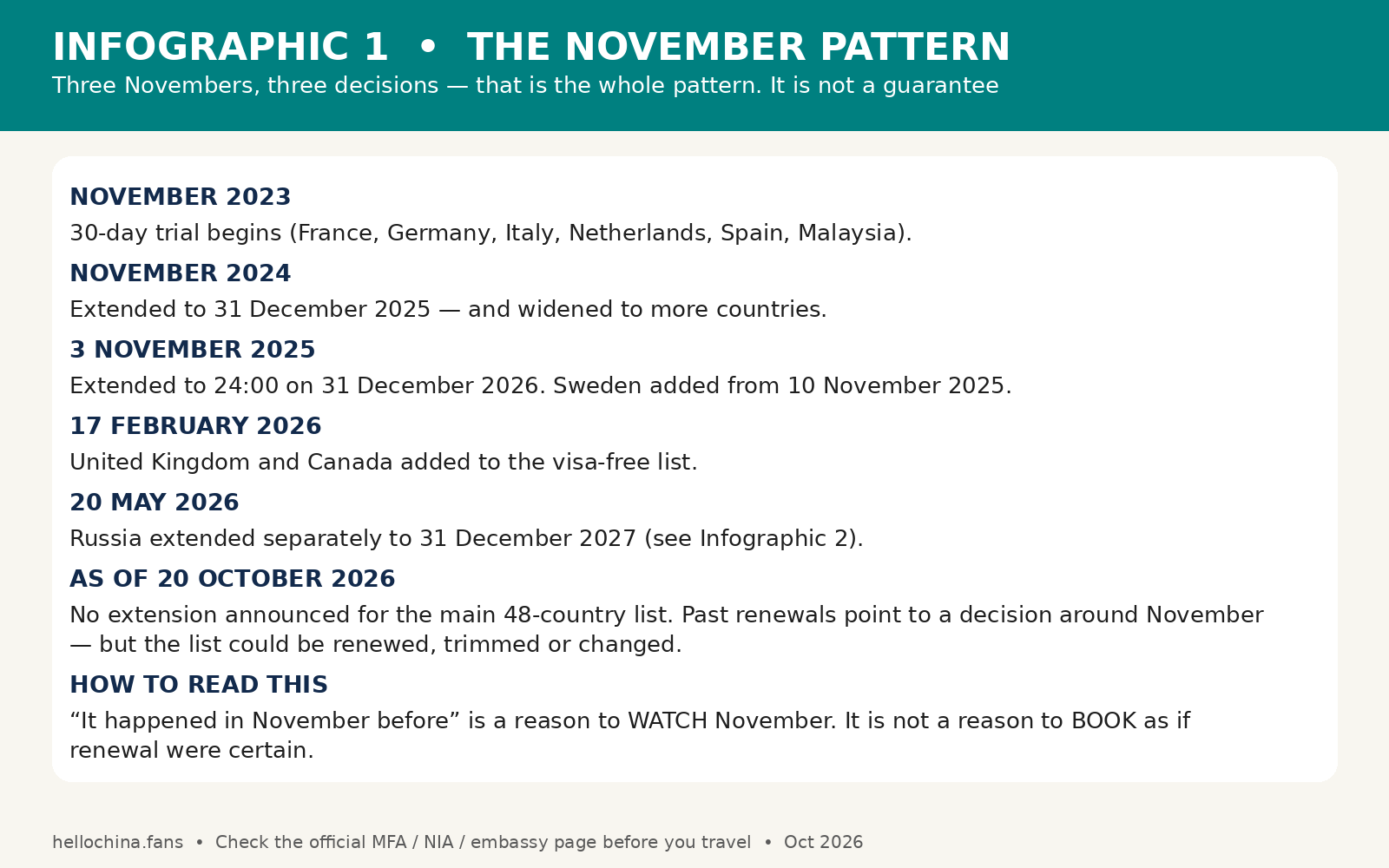
In November 2023, the 30-day trial began with a small group: France, Germany, Italy, Netherlands, Spain, and Malaysia. It was a trial, and trials are supposed to end or be judged. This one was judged favourably, and it grew.
In November 2024, the policy was extended to 31 December 2025 and widened to more countries. That is the first renewal, and it already tells you something important: the first decision point was not a cliff edge. It was a review, and the review extended the scheme.
On 3 November 2025, the policy was extended again, this time to 24:00 on 31 December 2026, and Sweden was added from 10 November 2025. That is the second renewal, and it is the announcement that created the deadline everyone is now worrying about. Read that sentence again, because it reframes the worry: the deadline is not a threat that appeared from nowhere. It is the end date of the last extension. Every extension so far has come with a new end date. That is how this policy has always worked. It has never been open-ended. It has been renewed in slices.
In 2026, two more dates matter. On 17 February 2026, the United Kingdom and Canada were added — less than a year before the current end date, which is why this feels personal for British and Canadian travellers. On 20 May 2026, Russia was extended separately to 31 December 2027, verified in more than one source. That proves extensions need not be blanket decisions: the next announcement could renew everyone, some countries, or different terms.
As of 20 October 2026, no extension had been announced for the main 48-country list. That sentence is the most important sentence in this article, and it needs to be read exactly as written. "No extension had been announced" does not mean "no extension will happen." It does not mean "extension has been refused." It means, on that date, the public record was silent. Silence before a November decision point is not news. It is the normal state of affairs before a November decision point. The last two renewals were announced in November. If you are watching for news, November is when to watch hardest — but watching is not the same as assuming.
What the November pattern proves — and what it does not
Now let us be honest about what a pattern can and cannot do for you.
What it proves is that this policy has been reviewed and renewed before, more than once, and that the reviews have happened in November. That is a real pattern, not a coincidence stretched over two data points. Three Novembers — a trial in November 2023, an extension in November 2024, an extension on 3 November 2025 — are enough to say, "If there is a decision, November is a plausible month for it." It is enough to plan your watching. It is enough to say to a friend, "Let us wait and see what November brings before we panic."
What it does not prove is the outcome. A pattern of renewal is not a promise of renewal. Governments change policies for reasons that have nothing to do with travel blogs: diplomacy, reciprocity, security, capacity, politics that travellers cannot see and should not pretend to predict. A list can be renewed as it stands. It can be trimmed. It can be widened. It can be given a shorter extension, or a longer one, or different conditions. The Russian example already shows that a single country's timetable can diverge from the main list. Anyone who tells you, today, that renewal is certain is selling you comfort, not information. Anyone who tells you that non-renewal is certain is selling you fear, not information. Both are guessing in a confident voice.
Nor does the pattern prove the next announcement will come in time for your booking — it may come late in November, with terms and a list to check line by line. "Wait for November" is a watching strategy, not a booking strategy. You still need a plan that works if November passes quietly or the announcement is narrower than hoped.
Who is not affected? Check before you worry
Before you build a plan around a deadline, check whether the deadline is even yours. This section has saved more travellers from pointless anxiety than any other part of this guide, because a surprising number of people worry about a date that does not govern their passport.
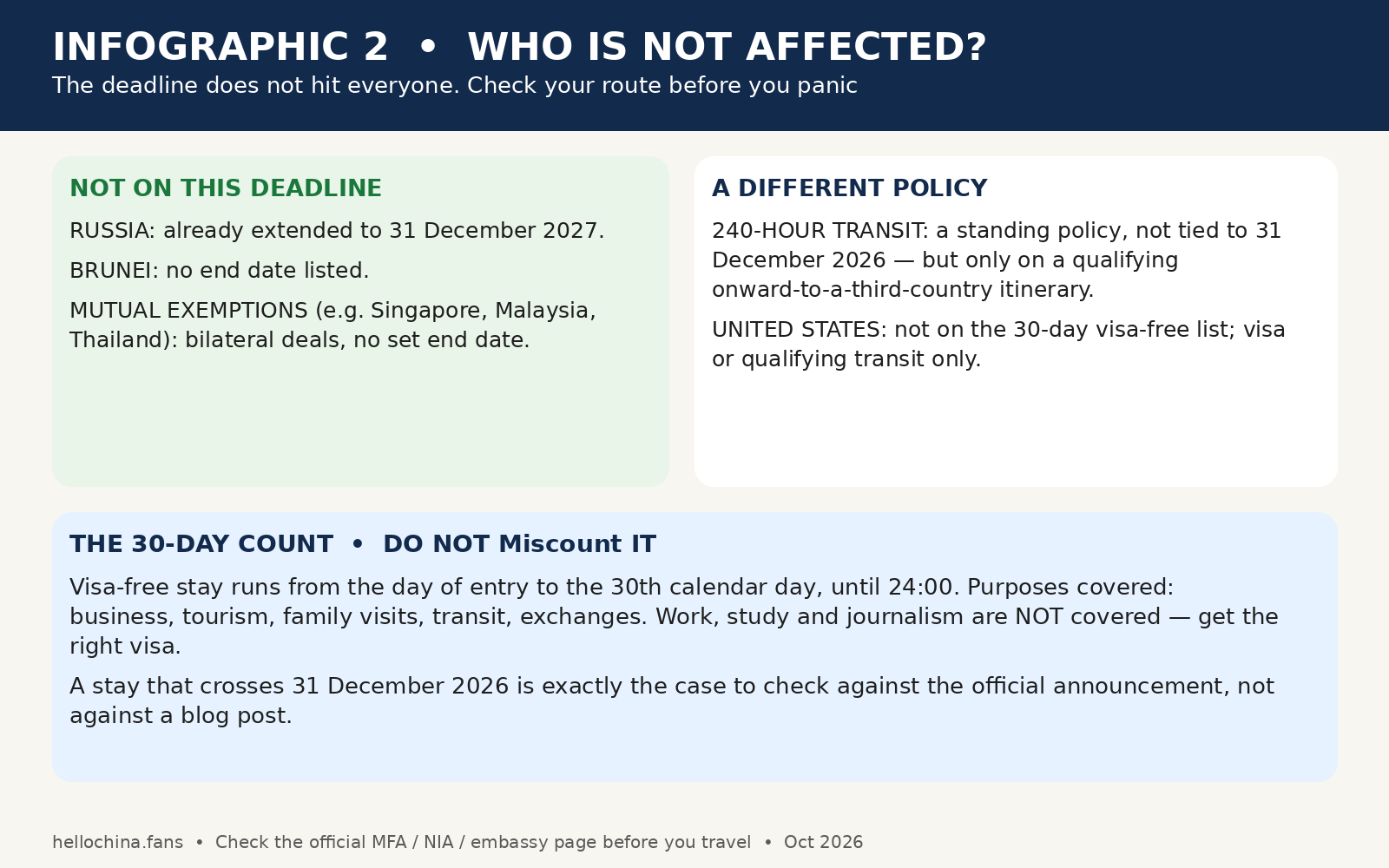
If you hold a Russian ordinary passport, your unilateral visa-free stay is already extended to 31 December 2027. You are not on the December 2026 clock. Plan to that date, and re-check it as it approaches, but do not borrow someone else's deadline.
If you hold a Brunei passport, the listing carries no end date. Again, a different position. If you hold a Singaporean, Malaysian, or Thai passport under a mutual exemption, your arrangement is bilateral and has no set end date in the same way. The point is not to memorise every country's position from a blog post. The point is to check your own passport against the official list, and to notice when the answer is "this deadline does not apply to me." That is a complete answer, and it ends the worry honestly.
If you are travelling on 240-hour transit, you are on a different policy altogether. It is not tied to 31 December 2026, but it has its own test, and that test is strict. You need a qualifying onward itinerary to a third country or region. Do not treat transit as a fallback for a holiday that does not qualify for it. Treat it as what it is: a real, useful, narrow permission for real transit journeys.
And if your stay will exceed 30 days, or your purpose is work, degree study, or journalism, visa-free entry does not cover you in any case. Those purposes require the right visa regardless of the December date. The deadline does not change that, and renewal would not change it either. If that is you, your planning starts with a visa, not with a news watch.
Counting matters: a stay runs from entry day to the 30th calendar day, until 24:00. A trip straddling 31 December 2026 must be checked against the official announcement, not a post or last year's rules.
Three scenarios, none of them predicted
Let us walk through the three futures, not to pick one, but to see what each one would ask of you. This is the part of planning that replaces anxiety with work.
Scenario one: the list is renewed broadly as it stands. Your February 2027 trip proceeds visa-free, subject to the new terms. Your work is small — re-check your passport is still listed — but the risk is assuming renewal before it happens and booking everything non-refundable on that assumption.
Scenario two: the list is renewed but trimmed or changed. This messy middle is entirely plausible — Russia already shows lists can diverge. Your work is to check the new list line by line for your passport. A headline saying "China extends visa-free" is not enough. You need the list.
Scenario three: the list is not renewed. A February 2027 trip then needs a visa, filed in advance — slower and costlier, but a known process millions do every year. The disaster is only arriving in February expecting a visa-free entry that no longer exists.
Notice what all three scenarios share: the traveller who survives all three is the traveller who has not bet the whole trip on one of them. That traveller is the subject of the next section.
A practical plan for a trip you have already booked
Here is the plan, in the order to do it. It is deliberately unglamorous, because unglamorous plans are the ones that work when announcements are late.
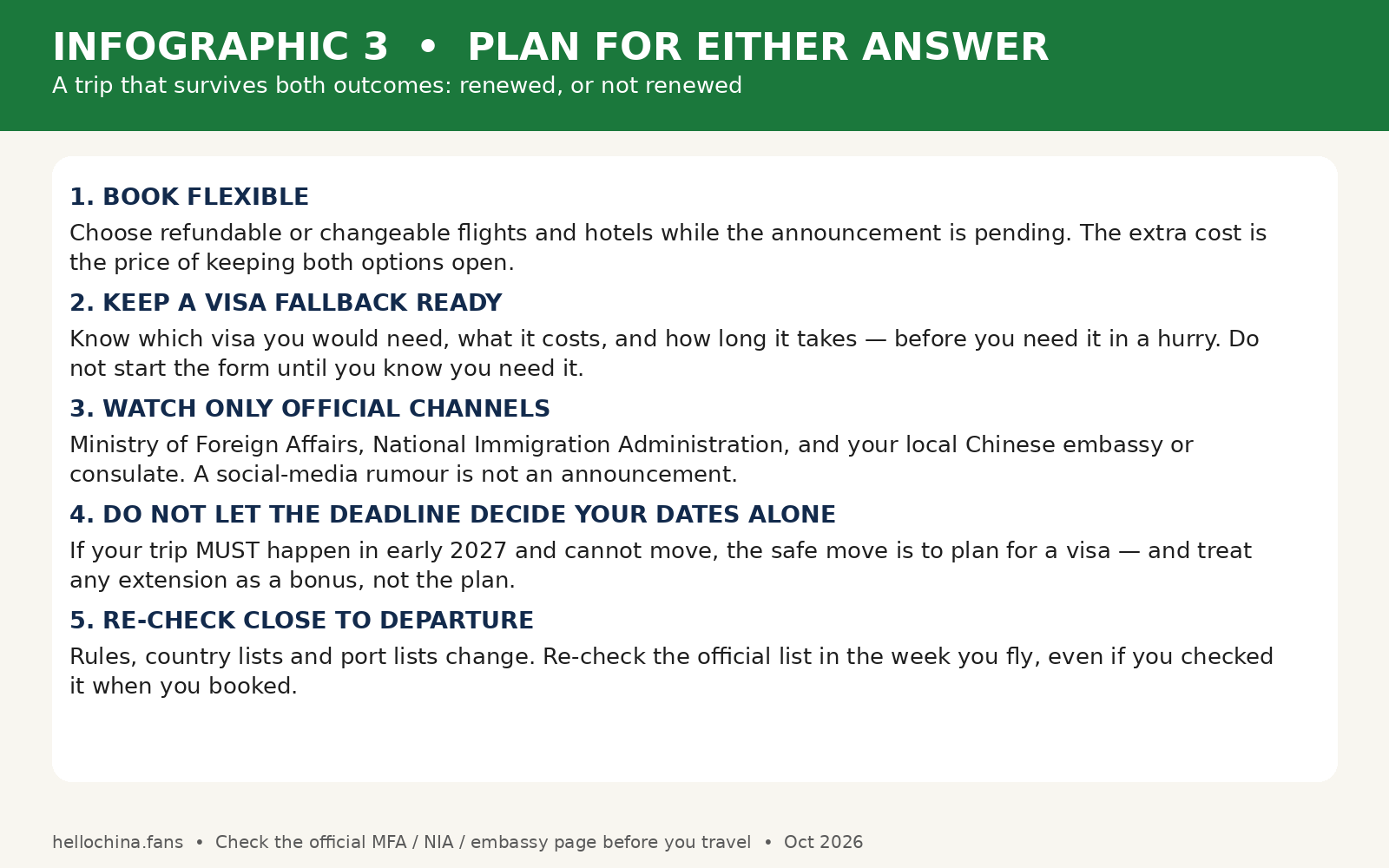
First, book flexible. While the announcement is pending, choose refundable or changeable flights and hotels where bearable. That extra cost keeps both options open without last-minute rebooking. If full flexibility is unaffordable, make at least the flight and first night changeable.
Second, keep a visa fallback ready without starting it yet: which visa, what it costs, how long it takes, what it requires. Do not file until you know you need it — visas have validity windows, and an October filing may not suit February. Knowing costs an evening; filing costs a decision.
Third, watch only official channels. The Ministry of Foreign Affairs, the National Immigration Administration, and your local Chinese embassy or consulate are the sources that count. A social-media rumour, a forwarded screenshot, or a confident blog post is not an announcement, even if it turns out to be right later. When the real announcement comes, it will be on an official page, with a list and a date. Until then, treat everything else as noise, however confident it sounds.
Fourth, do not let the deadline decide your dates alone. If your trip must happen in early 2027 and cannot move — a wedding, a conference, a family visit with fixed dates — the safe move is to plan for a visa, and to treat any extension as a bonus, not the plan. That sentence feels pessimistic. It is actually liberating, because it removes the deadline from the critical path. If renewal comes, you travel visa-free and you have saved a visa fee. If it does not, you already have the visa plan, and nothing is cancelled.
Fifth, re-check close to departure. Rules, country lists, and port lists change. Re-check the official list in the week you fly, even if you checked it when you booked. A traveller who checked in October and flew in February without re-checking has checked nothing that matters for February.
For groups: plan to the timeline of the member who needs a visa. A group that plans to its most privileged passport discovers the problem at check-in.
Frequently asked questions
Is China's 30-day visa-free stay ending on 31 December 2026? The current unilateral extension runs until 24:00 Beijing time on 31 December 2026. As of 20 October 2026, no extension had been announced for the main list. That is the public record on that date. It is not a prediction about what will happen next, and it should not be read as one.
Has it been extended before? Yes, in November. The trial began in November 2023, was extended in November 2024 to 31 December 2025, and was extended on 3 November 2025 to 31 December 2026, with Sweden added from 10 November 2025. The United Kingdom and Canada were added on 17 February 2026. Past renewal is a reason to watch November, not a guarantee of future renewal.
Does Russia's extension mean everyone is extended? No. Russia was extended separately, to 31 December 2027, announced on 20 May 2026. That shows extensions can be country-specific. A future announcement could renew everyone, some countries, or different terms. Check the list for your own passport.
Who is not affected by the 31 December 2026 date? Russian passport holders (to 31 December 2027), Brunei (no end date listed), and mutual-exemption countries such as Singapore, Malaysia, and Thailand (bilateral deals, no set end date) are not on this deadline. 240-hour transit is a separate standing policy, not tied to this date, but only for qualifying transit itineraries. United States passport holders are not on the 30-day list at all.
What should I do if my trip is in early 2027 and I have already booked? Book flexible where you can, keep a visa fallback ready without filing it yet, watch only official MFA, NIA, and embassy or consulate channels, and re-check the official list in the week you fly. If your dates cannot move, plan for a visa and treat any extension as a bonus.
How is the 30 days counted? From the day of entry to the 30th calendar day, until 24:00. Purposes covered include business, tourism, family visits, transit, and exchanges. Work, degree study, and journalism are not covered — get the appropriate visa for those purposes.
What if my trip crosses 31 December 2026? That is exactly the case to check against the official announcement, not against a blog post or last year's rules. Do not assume that an entry before the date guarantees a stay after it, or that a stay after the date is automatically covered. Read the announcement's wording for straddling stays, and ask your consulate if it is unclear.
The last word
Back at the kitchen table, the couple did something wise: they made the flight changeable, kept the visa fallback in a folder, and set a November reminder to check the official list, then decide. If renewal comes, they walk in visa-free. If not, they file for a visa. Either way, they go — because they planned for either answer, not one bet.
That is the whole lesson of this policy, and it is a generous one. History gives you a pattern to watch. It does not give you a promise to spend. Spend your money on flexibility, your attention on official sources, and your hope on the trip itself, not on a prediction. The trip is the part that matters. The announcement, whenever it comes, is just the door you walk through to get there.
This article is general information, not legal or consular advice. Visa and entry rules vary by nationality and change. Before you travel, check the official page of the Ministry of Foreign Affairs, the National Immigration Administration, and the Chinese embassy or consulate for your jurisdiction. If any detail here conflicts with an official source, the official source wins.
Read the full guide: https://hellochina.fans/guides/visas-entry