
Imperial & ritualMountains & peaksRivers & lakesOld town & lanesNight viewsBook ahead / busy
Southwest China
Chongqing
重庆 · CN-CQ
A vertical city on two rivers
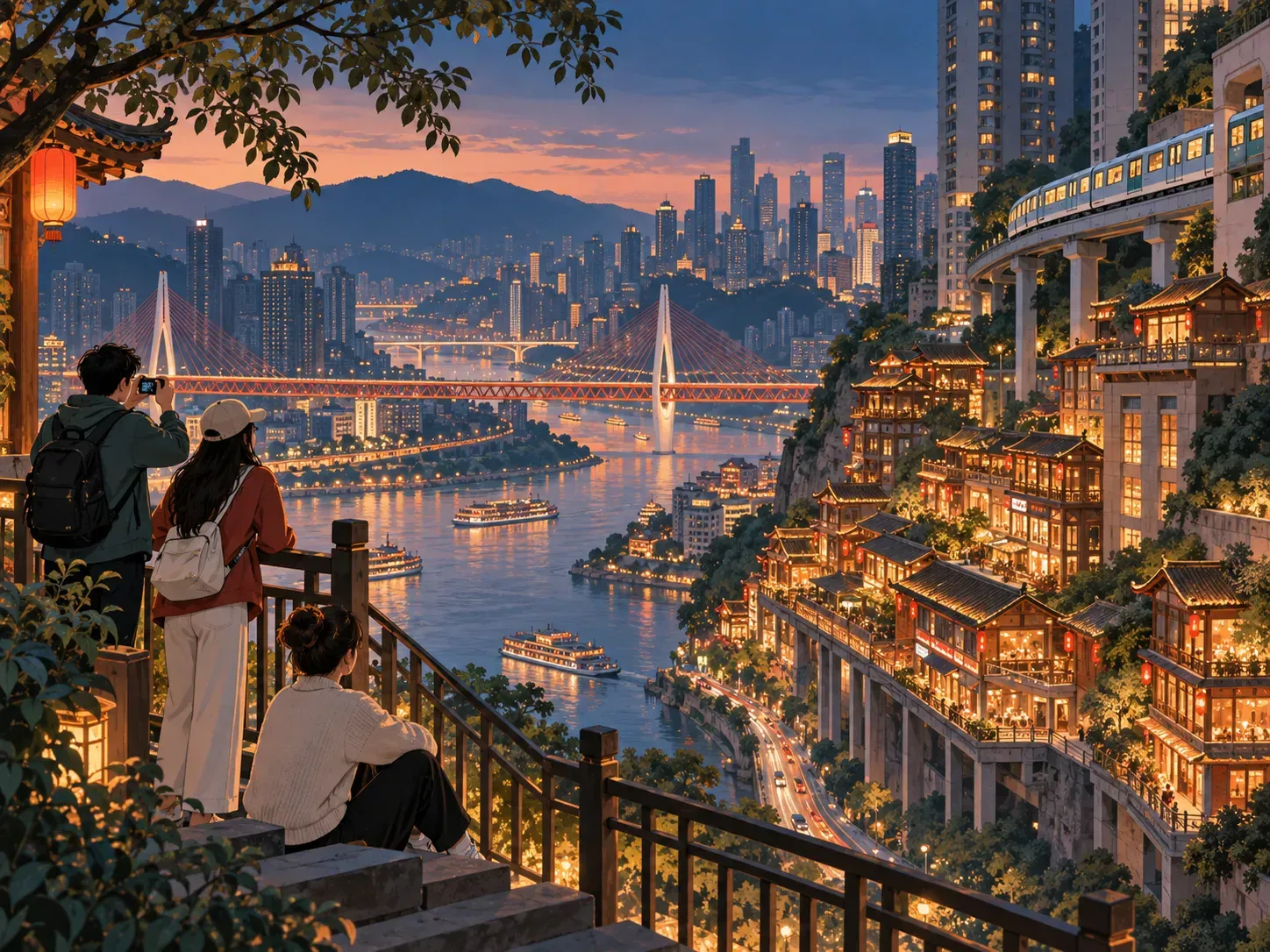
Built on hills between the Yangtze and the Jialing, so streets stack instead of spreading. Monorails run through apartment blocks, and the night skyline from Hongyadong is the reason people come.
English translations of the source blocks on this page were prepared with machine assistance and are under editorial review; the Chinese source text remains authoritative.
CityLandscapeFood
Where to start
- The Yuzhong peninsula & the mountain-city lanes
- The south bank's treaty-port buildings & Longmenhao
- Jinyun Mountain & Republican-era relics, Beibei
Read these before you plan
- P0Lock Dazu, Wulong, Fengjie and Hongyadong bookings first
Dazu books through the official public account; Baidicheng–Qutang and the Peak of Three Gorges run ticket reservation with daily caps; Hongyadong may require real-name time slots on weekends and holidays. Re-verify dates, slots and last check within 24 hours of departure, then schedule everything flexible around them.
- P0The core areas' minimum times have hit their floor
Shancheng Lane and Shibati at least 3 hours; Dazu's Baodingshan 3–4; the Three Natural Bridges 3–4 inside the area; Baidicheng 3–4 — below that only queues remain. Even Hongyadong's lights want 1.5 hours: the illumination is not something you 'pass by and see'.
- P0Choose lodging by main line — don't cross the river twice daily
Two or three city days: stay along the Yuzhong metro lines, covering Hongyadong, the lanes and the cableway. South-bank-heavy plans stay near Shangxinjie or Nanbin Road. County-line nights sleep in Wulong, Fengjie or Fulin the evening before — one fewer river-view room beats turning the next day's drive into a risk.
- P1Give the light to mornings and blue hour; skip hard noon
The lanes take morning side light; Hongyadong, Nanshan's One Tree and Nanbin Road belong to sunset into blue hour; the cableway at dusk catches the city lighting too. In summer, noon holds only indoors or short legs; in the county gorges enter in the morning — the deep valleys lose light fast after midday.
- P1Few, precise cores: build the mountain-city and Three Gorges lines
For the city line: the lanes' vertical drops, Hongyadong at night, the cableway and one south-bank river view. For the counties: one main line among Dazu, Wulong or Fengjie, with at least one real encounter — a Yangtze gorge or the carvings themselves. Don't schedule every night position on the same date.
- P2Heat, rain and closures all rewrite the city's step count
Chongqing summers are muggy — continuous climbing can cost more than winter. Under rainstorm or geohazard warnings, drop the mountain hikes and never enter closed walkways for rain shots. Museums close Mondays, and cable maintenance plus temporary caps override any guide's static numbers.
- P2Shoot residential, protected and sacred space by on-site order
Shancheng Lane, Shibati, Longmenhao and Ciqikou still hold residents: no entering courtyards, no occupying stairs, no doorways as sets. The carvings, temples and museums ban flash or line-crossing per rules; no railing-climbing, no fire-lane squatting, and never stop in traffic lanes or mid-bridge.
A · Core landmarks
Start with Chongqing's folded space and the Yangtze story
Hongyadong, the mountain-city lanes, the cableway, Jiefangbei, the Three Gorges Museum and Dazu together explain the city as mountain-water metropolis, engineering hub and heritage site. First visits build spatial sense on this layer.
B · Regional depth
From the peninsula to the south bank, Shapingba and Wulong
The south bank's treaty-port buildings, Nanshan's overlooks, Ciqikou, Jinyun Mountain and Wulong's karst extend Chongqing from 'viral nights' into modern history, near-city mountains and geology — for anyone with half a day to a day extra.
C · Slow corners
Completing the Yangtze, industrial and gorge-interior chapters
Baiheliang, the Wuling rift, 816, Baidicheng, the gorge peak and Beibei's Republican sites fill in hydrology, deep valleys, industry, the Three Gorges and the wartime capital. Longer transfers, clearer themes — for the experienced or the unhurried.
Suggested route shapes
- Central Chongqing on foot · 2–3 days
- Dazu or Beibei · 1–2 days
- Fuling–Fengjie Three Gorges line · 3 days
How to save money and time
Jiefangbei, the lanes, Shibati and the riverside roads carry enormous vertical drops: a few hundred metres on the map can be dozens of stair flights. Descend from Qixinggang or Jiaochangkou toward the river; at Longmenhao walk down from Shangxinjie metro to the water. It saves legs and the pointless elevator-and-climb loop.
Baodingshan, Beishan and the combo price differently; a first visit usually plans Baodingshan plus one transfer leg, not the two-mountain combo by reflex. Wulong's base fare runs low by season but the shuttle-plus-elevator combination commonly lands near ¥125 — confirm what's compulsory before choosing, and don't pay for parts you won't use.
Wulong reaches from Chongqing by rail in about 1.5 hours before the area's own transport; Dazu, Fuling and Fengjie likewise combine rail, coaches and direct buses. Compare charters only for groups or with seniors and children — and write the mountain roads and the return into the budget.
First visits: near Xiaoshizi, Jiaochangkou, Linjiangmen or Shangxinjie — walking plus metro covers Hongyadong, the lanes, the cableway and Longmenhao. View rooms earn their premium only if you'll live at the window; and the night before Wulong or Fengjie, sleep by the county sight rather than leaving the city pre-dawn.
March–May and October–November suit the lanes and county roads; in summer push Hongyadong, the lanes and the cableway to after dusk and give noon to museums. National holidays raise booking and queue costs sharply — secure the capped slots (Fengjie, Wulong) first.
Dazu, Wulong, Fuling and Fengjie point in different directions; 'all Chongqing counties' erases none of the transfer. Carvings say Dazu, karst says Wulong, the gorge says Fengjie; Fuling's Baiheliang, 816 and the rift make their own one-to-two-day line. The clearer the theme, the cheaper the tickets and transport.