
Mountains & peaksGardens & parksBook ahead / busy
East China
Suzhou
苏州 · CN-JS
Classical gardens and canals
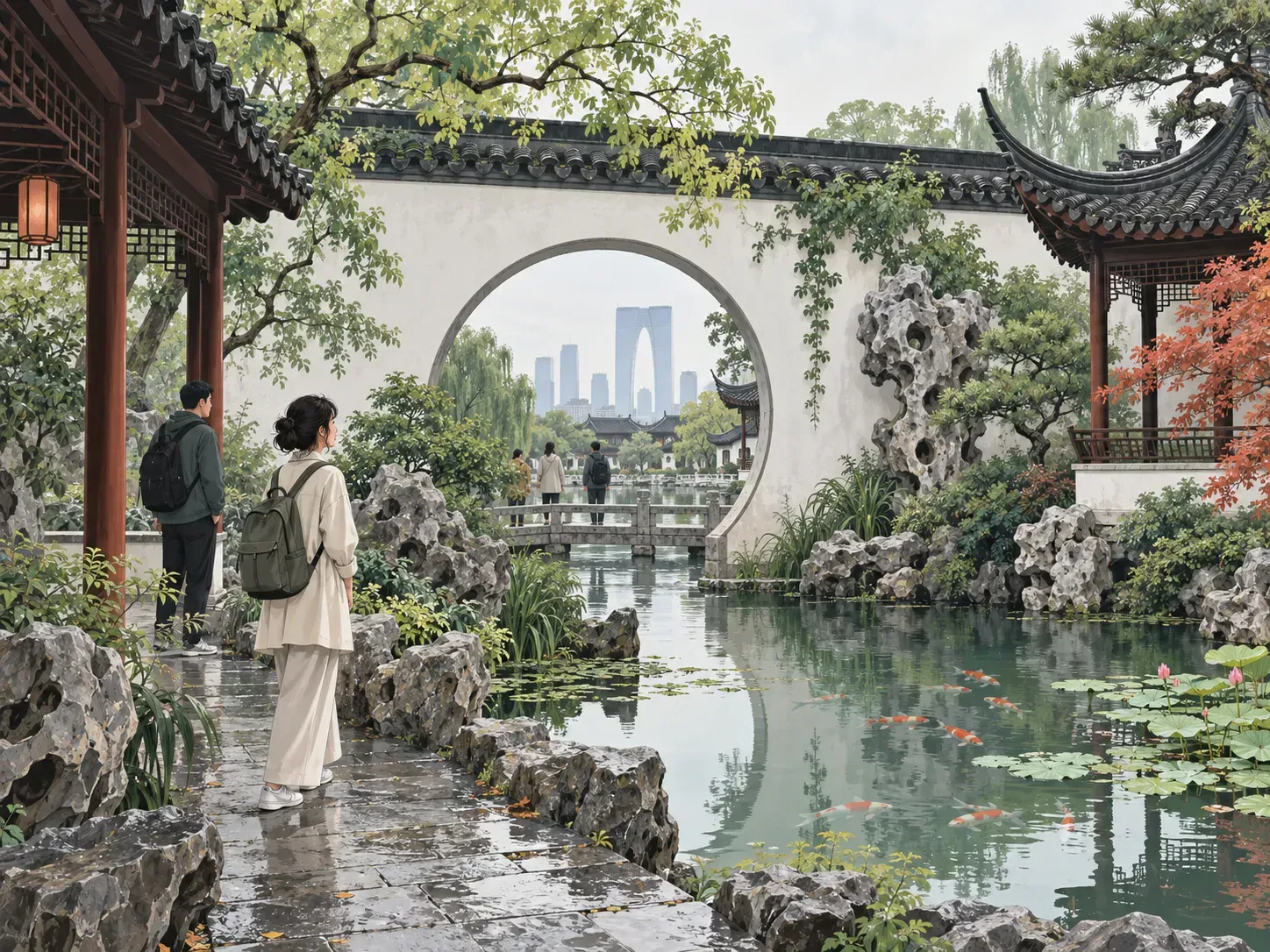
Nine UNESCO-listed classical gardens, a canal old town that is still lived in, and half an hour from Shanghai. Stay a night in the old town instead of day-tripping — the point is the early morning.
English translations of the source blocks on this page were prepared with machine assistance and are under editorial review; the Chinese source text remains authoritative.
HistoryArchitectureFood
Where to start
- Nanjing's Ming city wall & the Nanjing Museum
- Suzhou's classical gardens & the old town's water lanes
- Yangzhou's Slender West Lake & salt-merchant gardens
Read these before you plan
- P0Lock the reservations first, then build the intercity plan
Real-name booking items — the Nanjing Museum, Suzhou's Humble Administrator's and Lingering gardens, the Xuzhou Museum — are what most often reshape an itinerary. Official channels release tickets 1–7 days ahead; in peak season don't count on walk-up. If your first-choice Suzhou garden is gone, pivot to the Lingering or Master of the Nets garden.
- P0Don't keep compressing the minimum time at the core sights
Zhonghua Gate needs at least 2 hours, the Nanjing Museum 3, the Humble Administrator's Garden 2.5, Slender West Lake 3, Yuantouzhu 4 with the boat, and Huai'an's old town plus the caoyun museum at least 3. Below these, all that's left is transit and queues.
- P0Sleep inside the city's movement, not beside the sights
In Nanjing stay within metro reach of the wall and the Qinhuai; in Suzhou around Pingjiang Road or a metro entrance; in Yangzhou between the old town and the lake; in Xuzhou the Yunlong district serves the Han sites. Don't split three nights across three hotels — dawn and dusk light are worth more than a new address.
- P1Save the light for four high-return windows
The wall takes side light at opening or before sunset; the Humble Administrator's wants its first hour; Slender West Lake's evening belongs to the Five-Pavilion Bridge; Xijin Ferry climbs at blue hour. Cherry season at Yuantouzhu means crowds — buy the first entry and trade it for clean frames; midday generally suits only interiors.
- P1Keep the must-see list short and precise
At Zhonghua Gate, the barbican passages and soldier caves; at the Humble Administrator's, Yuanxiang Hall, Jianshan Lou and the borrowed water views; on the lake, the Five-Pavilion and Twenty-Four Bridges stretch; in Zhenjiang, Jinshan's tower plus Xijin's night lamps; at Yuantouzhu, Changchun Bridge and the cherry valley. One or two compositions per stop.
- P1Pace intercity moves by content density, not kilometres
Jiangsu's dense high-speed rail invites misjudgement: gardens, museums, old streets and archaeology all demand walking and reading time. One core city plus one light quarter per day at most; Nanjing–Zhenjiang and Suzhou–Wuxi chain naturally; Yangzhou–Huai'an–Xuzhou extend north on their own schedule.
- P2Let the day's notice override old prices; respect residents and protected edges
Fares, night sessions, boats, closures and free-entry days change often; don't hold a position through storms or closures. Old towns, old streets and temples remain living and sacred space: no entering courtyards, no climbing ancient buildings, no disturbing worship or performance — and photograph residents only with consent.
A · Core landmarks
Start with Jiangsu's first coordinates
Three cities fix Jiangsu's visual coordinates: the Ming wall, the Suzhou gardens and Slender West Lake stand for the capital, the private garden and the canal landscape. On a first visit, build your sense of the province along this intercity line.
B · Regional depth
From the core coordinates on to Jiangsu's second line
This layer covers the gardens, the ancient ferry and the Taihu lines of Suzhou, Yangzhou, Zhenjiang and Wuxi — the natural extension west or south after a first visit, and the finer re-reading for a second.
C · Slow corners
Depth spots for the experienced or the unhurried
Jiaoshan, the Master of the Nets Garden, Huai'an's caoyun sites and Xuzhou's Han remains complete the river-island, night-garden, canal and archaeology chapters. Not first-visit staples, but they pull Jiangsu back from 'gardens and water country' to true province scale.
Suggested route shapes
- Nanjing–Zhenjiang · 3–4 days
- Suzhou–Wuxi–Changzhou · 4 days
- Yangzhou–Huai’an–Xuzhou · 4–5 days
How to save money and time
High-speed rail makes the three cities feel close, but gardens, walls and the lake all cost walking time. Nanjing–Zhenjiang and Suzhou–Wuxi work as paired lines; Yangzhou, Huai'an and Xuzhou extend north. Within 10 days, don't chase all six cities — protect the three main lines first.
The Nanjing Museum, the Humble Administrator's and Lingering gardens, the Suzhou Museum and the Xuzhou Museum all run real-name booking, some releasing tickets 1–7 days ahead. Fix the core booking dates first, then work backwards to trains and lodging; in peak season, when the Humble Administrator's is sold out, the Lingering and Master of the Nets gardens are the standing alternatives.
Jinshan, Jiaoshan and Beigushan ticket separately; the combo pays only when you'll genuinely walk two or more. Jinshan plus Xijin Ferry is the half-day line and Jiaoshan takes its own half-day — sweeping all three to 'use up' the combo usually just adds boat queues, buses and rushing.
Even from the HSR stations, the old cores still need transfers — don't plan two cities in a day just because the trains are fast. In town, metro and bus first; compare ride-hailing only for groups on short hops. Suzhou's garden district has narrow roads and scarce parking: ride the metro and walk the last stretch.
Cherry season at Yuantouzhu and the lotus shows at the Humble Administrator's raise price and crowds together — online tickets ahead usually beat the gate. Off-season fares drop and light steadies, but don't expect specific blooms in the wrong months, and verify free-entry days separately.
Nanjing near the wall or the Qinhuai metro line, Suzhou around Pingjiang Road without demanding a garden-view room, Yangzhou between the old town and the lake. When changing cities, leave early and arrive by midday — two nights in one city covers dawn and dusk far better than a new hotel every night.
More in this region
ShanghaiBreak a global city back down into neighbourhoodsZhejiangBeyond Hangzhou: mountains, coast and old villagesAnhuiTwo kinds of China in one province, from Huizhou villages to the northern plainFujianBetween mountains and sea: ports, clans and migrationJiangxiAlong the Gan River and the old post roads, an underrated cultural landscape